Edicola votiva Madonna del Carmine
IT
- Location
- IT
- Category
- heritage historic sites
- Coordinates
- 40.7328572, 17.5782172
- Best time
- Morning or early afternoon
- Weather tip
- Check the local forecast before visiting.
Overview
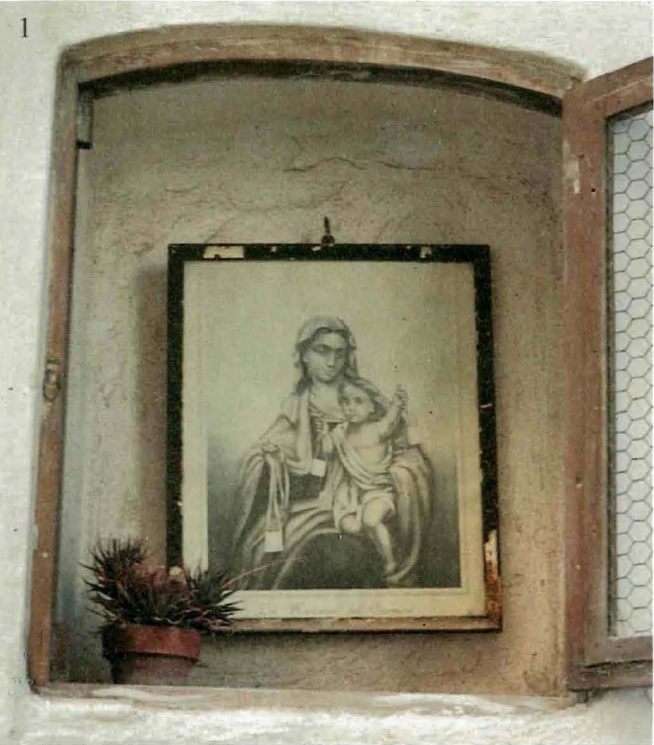
The Edicola Votiva Madonna del Carmine is a traditional votive shrine, designated as site number one in its local cataloging system. These structures, common throughout Italy, serve as small, street-side devotional monuments intended to provide a focal point for prayer and public piety. This specific shrine features a recessed niche that protects a paper print rendered in ink, depicting the Madonna del Carmine. The image of the Virgin Mary, often associated with the Carmelite Order and the Brown Scapular, is a recurring theme in Italian popular religious art. Visitors interested in exploring the evolution of local heritage and religious folk art will find this site a quiet, reflective stop. While small in scale, the edicola represents the historical intersection of private devotion and public urban space. For those seeking unique trip ideas, observing these shrines provides a deeper understanding of the socio-religious fabric of Italian communities. The site is best viewed during the morning or early afternoon when natural light illuminates the niche, allowing for a clearer view of the print. As these shrines are often integrated into the architectural facades of older buildings, they are integral to what to do in the area if you are interested in historical preservation and vernacular architecture. Please check the local weather forecast before visiting, as the shrine is exposed to the elements.
General information
The Edicola Votiva Madonna del Carmine is a traditional votive shrine, designated as site number one in its local cataloging system. These structures, common throughout Italy, serve as small, street-side devotional monuments intended to provide a focal point for prayer and public piety. This specific shrine features a recessed niche that protects a paper print rendered in ink, depicting the Madonna del Carmine. The image of the Virgin Mary, often associated with the Carmelite Order and the Brown Scapular, is a recurring theme in Italian popular religious art. Visitors interested in exploring the evolution of local heritage and religious folk art will find this site a quiet, reflective stop. While small in scale, the edicola represents the historical intersection of private devotion and public urban space. For those seeking unique trip ideas, observing these shrines provides a deeper understanding of the socio-religious fabric of Italian communities. The site is best viewed during the morning or early afternoon when natural light illuminates the niche, allowing for a clearer view of the print. As these shrines are often integrated into the architectural facades of older buildings, they are integral to what to do in the area if you are interested in historical preservation and vernacular architecture. Please check the local weather forecast before visiting, as the shrine is exposed to the elements.
Did you know
- Votive shrines like this were historically placed at street corners to provide spiritual protection to travelers and residents.
- The Madonna del Carmine, or Our Lady of Mount Carmel, is one of the most venerated titles of the Virgin Mary in Italy.
- The use of paper prints in niche shrines became widespread in the 18th and 19th centuries as a way to make religious imagery accessible to the general public.
History
Votive shrines, or 'edicole votive,' have been a fixture of the Italian urban landscape for centuries. They evolved from ancient Roman traditions of household shrines, known as 'lararia,' which were moved to public street corners to protect neighborhoods. This specific edicola, cataloged as site number one, preserves a paper print of the Madonna del Carmine. Such prints were often commissioned by local confraternities or wealthy families to demonstrate their piety and to foster a sense of communal religious identity. While the specific date of this shrine's construction is not documented in available records, its presence reflects the long-standing tradition of placing sacred images in public view to offer comfort and spiritual guidance to passersby.
Cultural significance
The cultural significance of the Edicola Votiva Madonna del Carmine lies in its role as a bridge between high ecclesiastical art and popular devotion. In Italian culture, these shrines act as 'open-air churches' where the sacred is integrated directly into the daily commute of the citizen. The Madonna del Carmine is a symbol of protection and intercession, particularly for the souls in Purgatory, making this shrine a site of significant emotional resonance for local believers. By maintaining these sites, communities preserve a vernacular history that is often ignored by grander architectural surveys, highlighting the importance of everyday faith in the shaping of Italian urban identity.
Geography and landscape
The Edicola Votiva Madonna del Carmine is situated within an urban context, likely embedded into the masonry of a historic building or a boundary wall. These shrines are typically positioned at eye level or slightly above, designed to be visible to pedestrians moving through narrow streets or alleyways. The surrounding landscape is defined by the dense, historical architecture characteristic of traditional Italian towns. Because the shrine is an outdoor installation, its physical condition is directly influenced by the local climate, necessitating its placement in a sheltered niche to protect the fragile paper print from direct rain and wind. Its location is a testament to the organic way historical markers are woven into the fabric of Italian settlements.
More facts
- Imported from OSM batch
Visitor links
Nearby attractions
- Edicola votiva San Biagio, Madonna del Carmine e Anime Purganti, Sant’Oronzo 54 m
- Edicola votiva della Madonna del Carmine o di Sant’Oronzo (?) 64 m
- Edicola votiva Immacolata 74 m
- Edicola votiva (Via Pompeo Patrelli) 79 m
- Edicola votiva Cuore di Gesù 82 m
- Edicola votiva Cuore di Gesù 84 m
- Edicola votiva San Pasquale Baylon 88 m
- Edicola votiva (Via Gaspare Petrarolo) 93 m