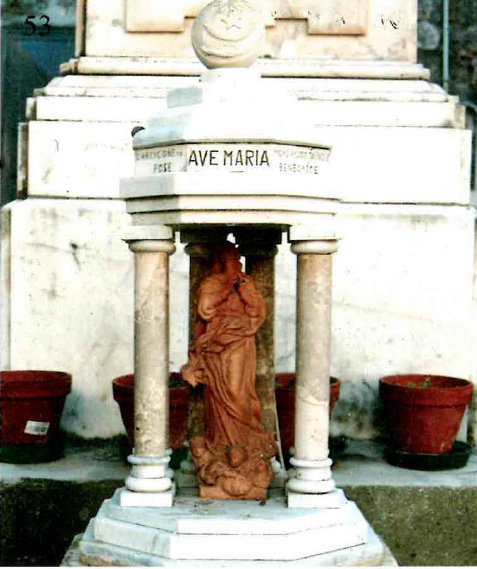
Edicola votiva Immacolata
IT
- Location
- IT
- Category
- heritage historic sites
- Coordinates
- 40.7324911, 17.5774859
- Best time
- Morning or early afternoon
- Weather tip
- Check the local forecast before visiting.
Overview
The Edicola votiva Immacolata, identified as niche number 53, is a traditional devotional structure housing a terracotta statue dedicated to the Immaculate Conception. These street-side shrines, common throughout Italian towns and cities, served as vital centers for neighborhood piety and community identity, particularly during the 18th and 19th centuries. Visitors observing this site will find a refined example of religious folk art, characterized by the delicate craftsmanship of the terracotta figure. As part of a broader network of urban religious markers, the niche offers a glimpse into the historical practice of public devotion. For those planning their trip ideas, exploring these scattered votive shrines provides a unique perspective on the intersection of faith and public space in Italian urban architecture. While the niche is small, it stands as a testament to the enduring cultural heritage of the area. Travelers interested in local history often include these sites when mapping out walking tours to uncover the hidden artistic details of the city. Whether you are an architecture enthusiast or a history buff, the Edicola votiva Immacolata represents a significant, if understated, element of the local landscape. Ensure you check the local weather forecast before visiting to fully enjoy your walk through the historic streets, as these outdoor installations are best appreciated in clear, natural light.
General information
The Edicola votiva Immacolata, identified as niche number 53, is a traditional devotional structure housing a terracotta statue dedicated to the Immaculate Conception. These street-side shrines, common throughout Italian towns and cities, served as vital centers for neighborhood piety and community identity, particularly during the 18th and 19th centuries. Visitors observing this site will find a refined example of religious folk art, characterized by the delicate craftsmanship of the terracotta figure. As part of a broader network of urban religious markers, the niche offers a glimpse into the historical practice of public devotion. For those planning their trip ideas, exploring these scattered votive shrines provides a unique perspective on the intersection of faith and public space in Italian urban architecture. While the niche is small, it stands as a testament to the enduring cultural heritage of the area. Travelers interested in local history often include these sites when mapping out walking tours to uncover the hidden artistic details of the city. Whether you are an architecture enthusiast or a history buff, the Edicola votiva Immacolata represents a significant, if understated, element of the local landscape. Ensure you check the local weather forecast before visiting to fully enjoy your walk through the historic streets, as these outdoor installations are best appreciated in clear, natural light.
Did you know
- Votive niches were often commissioned by local guilds or wealthy families to protect the neighborhood.
- The terracotta medium was favored for these outdoor shrines due to its durability and relative affordability compared to marble.
- Niche number 53 is part of a cataloged series of urban devotional sites documented by local heritage organizations.
History
Votive niches like the Edicola votiva Immacolata became widespread in Italy during the Counter-Reformation period. They were intended to encourage private prayer in public spaces, effectively transforming the street into an extension of the church. The use of terracotta for the central statue reflects the artisanal traditions of the period, where local sculptors were commissioned to create durable, weather-resistant images. Over the centuries, these shrines have been maintained by local residents, serving as silent witnesses to the evolving social and religious history of the surrounding community. While individual records for the construction of niche number 53 are sparse, its existence aligns with the widespread practice of installing Marian iconography in urban centers to provide spiritual comfort to passersby.
Cultural significance
The Edicola votiva Immacolata serves as a tangible link to the cultural practice of 'vicinato' or neighborhood devotion. In Italian urban history, these shrines were not merely decorative; they were focal points for community gatherings, processions, and daily rituals. The choice of the Immaculate Conception as the subject matter highlights the deep-rooted theological importance of this dogma in Italian Catholic tradition. By preserving such sites, the community maintains a connection to its historical identity, honoring the craftsmanship of past generations and the spiritual continuity that has defined the urban landscape for centuries.
Geography and landscape
The niche is situated within the dense urban fabric, typically integrated into the facade of a historic building or positioned at a street corner. This placement is deliberate, designed to be visible to residents and travelers moving through the city's narrow, winding corridors. The surrounding landscape is defined by traditional masonry, stone paving, and the characteristic architectural density of Italian historic centers. These shrines often act as markers for navigation within the complex urban layout, providing a sense of place and historical depth to the modern streetscape.
More facts
- Imported from OSM batch
Visitor links
Nearby attractions
- Edicola votiva Cuore di Gesù 9 m
- Edicola votiva Madonna del Carmine 74 m
- Edicola votiva Cuore di Gesù 97 m
- Edicola votiva Immacolata 111 m
- Edicola votiva (Via Gaspare Petrarolo) 114 m
- Edicola votiva San Biagio, Madonna del Carmine e Anime Purganti, Sant’Oronzo 124 m
- Edicola votiva Santi Medici 133 m
- Edicola votiva della Madonna del Carmine o di Sant’Oronzo (?) 137 m