Edicola votiva Cuore di Gesù
IT
- Location
- IT
- Category
- heritage historic sites
- Coordinates
- 40.7321436, 17.5785441
- Best time
- Morning or early afternoon
- Weather tip
- Check the local forecast before visiting.
Overview
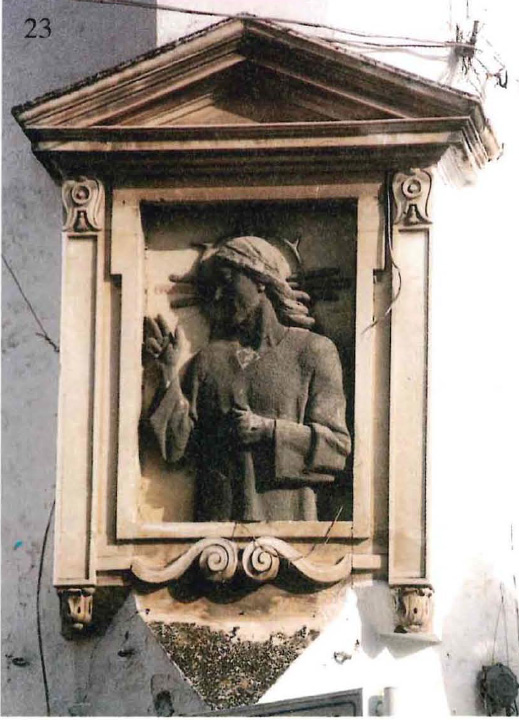
The Edicola Votiva Cuore di Gesù, identified as niche number 23, serves as a poignant example of Italian devotional street art. This small, protected structure houses a bas-relief crafted from cast cement, depicting the Sacred Heart of Jesus. Historically, such votive shrines—or 'edicole votive'—were commissioned by local families or neighborhoods as expressions of faith, protection, or thanksgiving. They are frequently found embedded into the facades of historic urban buildings or placed at street corners, acting as silent witnesses to the daily lives of residents across Italian towns. Visitors interested in the intersection of religious practice and urban architecture will find these shrines to be essential local attractions that offer a glimpse into the traditional spiritual landscape of Italy. While small in scale, the Cuore di Gesù niche provides valuable insight into the craftsmanship of early 20th-century religious art. For those planning their itinerary, exploring these hidden historical markers is one of the most rewarding trip ideas for travelers who appreciate the subtle, layered history found in the quiet corners of the country. Whether you are walking through narrow alleys or exploring main squares, these shrines invite a moment of quiet reflection. It is recommended to visit during the morning or early afternoon to take advantage of natural light, which highlights the texture of the cast cement relief. Always check the local weather forecast before setting out to ensure a comfortable experience.
General information
The Edicola Votiva Cuore di Gesù, identified as niche number 23, serves as a poignant example of Italian devotional street art. This small, protected structure houses a bas-relief crafted from cast cement, depicting the Sacred Heart of Jesus. Historically, such votive shrines—or 'edicole votive'—were commissioned by local families or neighborhoods as expressions of faith, protection, or thanksgiving. They are frequently found embedded into the facades of historic urban buildings or placed at street corners, acting as silent witnesses to the daily lives of residents across Italian towns. Visitors interested in the intersection of religious practice and urban architecture will find these shrines to be essential local attractions that offer a glimpse into the traditional spiritual landscape of Italy. While small in scale, the Cuore di Gesù niche provides valuable insight into the craftsmanship of early 20th-century religious art. For those planning their itinerary, exploring these hidden historical markers is one of the most rewarding trip ideas for travelers who appreciate the subtle, layered history found in the quiet corners of the country. Whether you are walking through narrow alleys or exploring main squares, these shrines invite a moment of quiet reflection. It is recommended to visit during the morning or early afternoon to take advantage of natural light, which highlights the texture of the cast cement relief. Always check the local weather forecast before setting out to ensure a comfortable experience.
Did you know
- Votive shrines like this one were often placed at street corners to provide spiritual comfort to passersby.
- The use of cast cement for religious art became popular in the early 20th century as a durable and affordable medium.
- Niche number 23 is part of a larger network of cataloged devotional sites.
History
Votive shrines have been a fixture of the Italian landscape for centuries, evolving from ancient Roman 'lararia'—small household shrines dedicated to the spirits of the home. The Edicola Votiva Cuore di Gesù represents a later iteration of this tradition, likely dating to the late 19th or early 20th century. During this period, the cult of the Sacred Heart saw a significant resurgence in Italy, leading to the widespread installation of such bas-reliefs in public spaces. These objects were intended to serve as permanent reminders of faith, often maintained by the residents of the building where they were installed.
Cultural significance
The cultural significance of the Edicola Votiva Cuore di Gesù lies in its role as a bridge between private devotion and public life. In Italian culture, these shrines transformed the street into a sacred space, marking boundaries and providing a focal point for communal prayer. They represent the 'religion of the people,' distinct from the formal liturgy held inside cathedrals. By preserving these niches, local communities maintain a tangible connection to the social and spiritual values of their ancestors, reinforcing a shared identity that is deeply embedded in the historical urban fabric.
Geography and landscape
The Edicola Votiva Cuore di Gesù is situated within an urban environment, typical of traditional Italian architectural settings. These shrines are almost exclusively found integrated into the masonry of historic structures, often at eye level or slightly elevated to protect them from traffic. The surrounding landscape is defined by dense, historic building facades, narrow pedestrian streets, and the rhythmic pattern of urban life. The placement of niche number 23 is deliberate, positioned to be visible to those navigating the local thoroughfares, thereby serving as a landmark within the neighborhood's layout.
More facts
- Imported from OSM batch
Visitor links
Nearby attractions
- Edicola votiva Immacolata 45 m
- Edicola votiva Madonna del Carmine 84 m
- Edicola votiva San Biagio, Madonna del Carmine e Anime Purganti, Sant’Oronzo 89 m
- Edicola Votiva San Biagio, Madonna del Carmine, Sant’Oronzo, Colomba dello Spirito Santo 89 m
- Edicola votiva Immacolata 97 m
- Edicola votiva Cristo spirante 104 m
- Edicola votiva Cuore di Gesù 106 m
- Edicola votiva Madonna del Carmine e San Simone Stock 114 m