Edicola votiva Santi Medici
IT
- Location
- IT
- Category
- heritage historic sites
- Coordinates
- 40.7313167, 17.5771939
- Best time
- Morning or early afternoon
- Weather tip
- Check the local forecast before visiting.
Overview
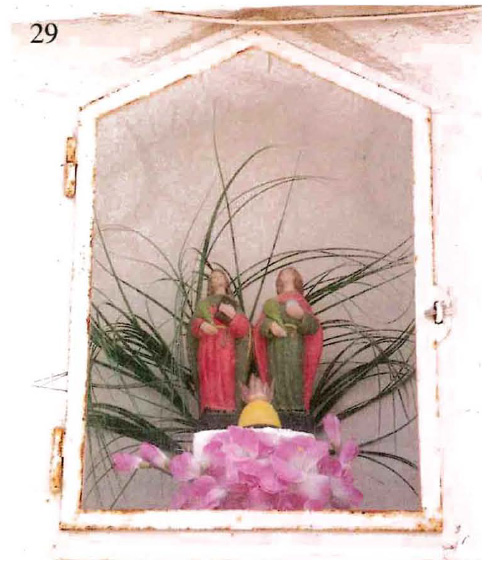
The Edicola votiva Santi Medici, identified as niche number 29, is a traditional votive shrine located in Italy. These structures, often found embedded in the walls of historic buildings or along public thoroughfares, serve as vital markers of local folk religion and community devotion. The primary feature of this specific edicola is a painted terracotta statue depicting the Santi Medici—the Holy Physicians, Saints Cosmas and Damian. These saints have historically been venerated for their role as healers, and their presence in a street-side niche reflects the deep-seated tradition of seeking divine protection and health within the urban fabric. Visitors interested in the intersection of religious history and local heritage will find this site a compelling example of popular piety. While these shrines are often overlooked by casual passersby, they offer a unique glimpse into the daily devotional life of past generations. When planning your trip ideas for exploring Italy's hidden historical gems, these small, often overlooked monuments provide a fascinating look at regional artistic traditions. Whether you are walking through historic districts or researching local attractions, the Edicola votiva Santi Medici stands as a testament to the enduring nature of public religious art. It is recommended to visit during daylight hours to best appreciate the craftsmanship of the terracotta figure and the architectural details of the niche.
General information
The Edicola votiva Santi Medici, identified as niche number 29, is a traditional votive shrine located in Italy. These structures, often found embedded in the walls of historic buildings or along public thoroughfares, serve as vital markers of local folk religion and community devotion. The primary feature of this specific edicola is a painted terracotta statue depicting the Santi Medici—the Holy Physicians, Saints Cosmas and Damian. These saints have historically been venerated for their role as healers, and their presence in a street-side niche reflects the deep-seated tradition of seeking divine protection and health within the urban fabric. Visitors interested in the intersection of religious history and local heritage will find this site a compelling example of popular piety. While these shrines are often overlooked by casual passersby, they offer a unique glimpse into the daily devotional life of past generations. When planning your trip ideas for exploring Italy's hidden historical gems, these small, often overlooked monuments provide a fascinating look at regional artistic traditions. Whether you are walking through historic districts or researching local attractions, the Edicola votiva Santi Medici stands as a testament to the enduring nature of public religious art. It is recommended to visit during daylight hours to best appreciate the craftsmanship of the terracotta figure and the architectural details of the niche.
Did you know
- Votive shrines like this one were often commissioned by local guilds or neighborhood associations.
- The Saints Cosmas and Damian are traditionally considered the patron saints of physicians and surgeons.
- Terracotta was a favored material for such shrines due to its durability and relative affordability for local artisans.
History
Votive shrines, or 'edicole', have been a fixture of Italian urban landscapes since the Middle Ages. They were traditionally erected to provide a focal point for prayer in areas where a church might not be immediately accessible. The use of terracotta for religious statuary became particularly widespread during the Renaissance and Baroque periods, as it allowed for detailed, expressive figures that could be painted to mimic more expensive materials. This specific niche, marked as number 29, represents a long-standing tradition of maintaining small-scale religious art within the public sphere, serving as a silent witness to the social and religious history of its surroundings.
Cultural significance
The cultural significance of the Edicola votiva Santi Medici lies in its role as a bridge between high art and popular faith. By placing the image of the Holy Physicians in a public street-side niche, the community integrated the sacred into their everyday environment. These shrines were often sites of small offerings, where residents would leave flowers or candles to petition for health or recovery. This practice highlights the historical importance of the Santi Medici in Italian culture, where they were frequently invoked to ward off illness and provide comfort to the sick, cementing their place in the collective consciousness of the local population.
Geography and landscape
The Edicola votiva Santi Medici is integrated into the built environment, typically found set into the masonry of a wall or facade. It is a feature of the urban landscape rather than a natural one, functioning as an architectural ornament that punctuates the streetscape. Its placement is intentional, designed to be visible to pedestrians traversing the local thoroughfares. The setting is usually characterized by historic masonry, narrow streets, and the dense, multi-layered architecture common to Italian towns. The preservation of the niche is directly linked to the maintenance of the building structure it is embedded within.
More facts
- Imported from OSM batch
Visitor links
Nearby attractions
- Edicola votiva Cristo spirante 74 m
- Edicola votiva Immacolata 78 m
- Edicola votiva San Biagio, Madonna del Carmine, Sant’Oronzo, Colomba dello Spirito Santo 87 m
- Edicola votiva Madonna della Grata 109 m
- Edicola votiva Crocifissione 110 m
- Edicola votiva Immacolata 112 m
- Edicola votiva Cuore di Gesù 131 m
- Edicola votiva Immacolata 133 m