Edicola votiva Immacolata
IT
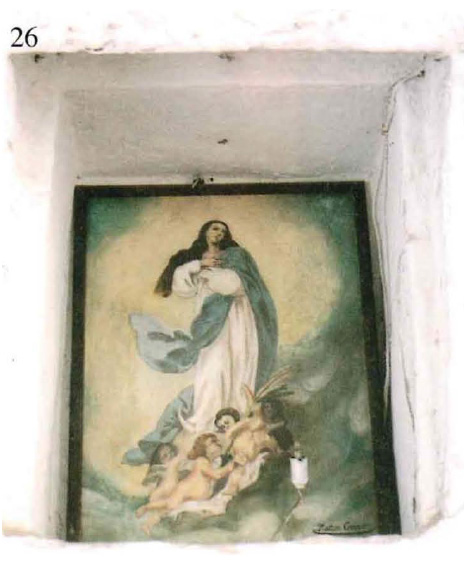
- Location
- IT
- Category
- heritage historic sites
- Coordinates
- 40.73176, 17.5783853
- Best time
- Morning or early afternoon
- Weather tip
- Check the local forecast before visiting.
Overview
The Edicola votiva Immacolata, identified as niche number 26, is a traditional Italian votive shrine that serves as a testament to the long-standing practice of public devotion in urban spaces. These small, often street-side structures were historically commissioned to provide a focal point for prayer and to offer protection to the neighborhood. The centerpiece of this specific edicola is a delicate oil painting on copper depicting the Immaculate Conception. Visitors interested in exploring the heritage of local religious art will find this site a compelling example of how piety was integrated into the daily architectural fabric of Italian towns. As you consider various trip ideas for your cultural exploration, these small shrines offer a unique, intimate look at local history that is often overlooked in favor of larger monuments. The preservation of the oil-on-copper medium highlights the artistic dedication even in minor structures. Whether you are walking through the historic center or seeking out hidden gems, the Edicola votiva Immacolata provides a quiet moment of reflection. It is an excellent stop for those looking for authentic places to visit that reveal the spiritual and social history of the region. Please note that as these are outdoor heritage sites, it is recommended to visit during daylight hours to fully appreciate the craftsmanship of the painting housed within the niche.
General information
The Edicola votiva Immacolata, identified as niche number 26, is a traditional Italian votive shrine that serves as a testament to the long-standing practice of public devotion in urban spaces. These small, often street-side structures were historically commissioned to provide a focal point for prayer and to offer protection to the neighborhood. The centerpiece of this specific edicola is a delicate oil painting on copper depicting the Immaculate Conception. Visitors interested in exploring the heritage of local religious art will find this site a compelling example of how piety was integrated into the daily architectural fabric of Italian towns. As you consider various trip ideas for your cultural exploration, these small shrines offer a unique, intimate look at local history that is often overlooked in favor of larger monuments. The preservation of the oil-on-copper medium highlights the artistic dedication even in minor structures. Whether you are walking through the historic center or seeking out hidden gems, the Edicola votiva Immacolata provides a quiet moment of reflection. It is an excellent stop for those looking for authentic places to visit that reveal the spiritual and social history of the region. Please note that as these are outdoor heritage sites, it is recommended to visit during daylight hours to fully appreciate the craftsmanship of the painting housed within the niche.
Did you know
- The use of copper as a base for oil paintings was favored for its durability and smooth surface, which allowed for fine detail.
- Votive shrines like the Edicola Immacolata were often maintained by local residents as a form of community devotion.
- The Immaculate Conception is a common subject for Italian votive art, representing the belief in the purity of the Virgin Mary.
History
Votive shrines, or edicole votive, have been a fixture of Italian streetscapes since the medieval period, gaining significant popularity during the Counter-Reformation. They were frequently erected at street corners or integrated into building facades to mark sacred boundaries and encourage public prayer. The specific use of oil on copper for the image of the Immaculate Conception suggests a tradition of commissioning professional or semi-professional artists to decorate these neighborhood shrines, ensuring that the devotional image remained vibrant despite exposure to the elements over time. While the exact date of this specific shrine's construction is not documented, its inclusion in a numbered series indicates a systematic approach to cataloging and preserving these heritage sites.
Cultural significance
The Edicola votiva Immacolata represents the intersection of private faith and public life. Culturally, these shrines served as neighborhood landmarks, acting as anchors for the local community. They provided a space where individuals could pause during their daily routines to offer a prayer, thus weaving religion into the social fabric of the city. The presence of the Immaculate Conception image specifically points to the deep-rooted influence of Marian devotion in Italy, which has historically played a central role in both personal piety and communal identity. These sites remind us that history is not just found in cathedrals, but in the small, everyday manifestations of belief found on the corners of our streets.
Geography and landscape
The Edicola votiva Immacolata is situated within the dense urban fabric typical of historic Italian settlements. As a street-facing niche, it is integrated into the existing architectural environment, likely positioned at a corner or along a thoroughfare where pedestrians would naturally pass. Its location is characteristic of urban heritage sites that are embedded directly into the walls of residential or commercial buildings. The landscape here is defined by the surrounding masonry, narrow streets, and the interplay of light and shadow that characterizes historic city centers. Visitors will find that the shrine is inseparable from the urban density of the area, serving as a quiet, static point of interest within a bustling, lived-in environment.
More facts
- Imported from OSM batch
Visitor links
Nearby attractions
- Edicola votiva Cuore di Gesù 45 m
- Edicola votiva Cristo spirante 60 m
- Edicola votiva Immacolata 83 m
- Edicola votiva Madonna del Carmine e San Simone Stock 103 m
- Edicola votiva Immacolata 111 m
- Edicola votiva Santi Medici 112 m
- Edicola votiva Cuore di Gesù 117 m
- Edicola votiva Madonna della Grata 120 m