Edicola votiva San Giovannino
IT
- Location
- IT
- Category
- heritage historic sites
- Coordinates
- 40.7339995, 17.5789493
- Best time
- Morning or early afternoon
- Weather tip
- Check the local forecast before visiting.
Overview
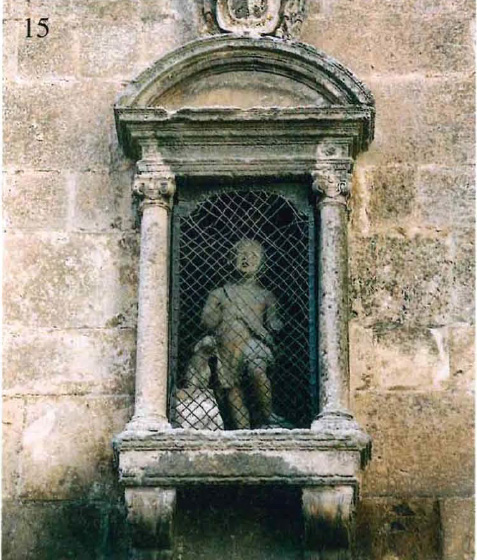
The Edicola votiva San Giovannino, cataloged as number 15, is a significant religious niche located on the lateral facade of the cathedral. This architectural feature houses a stone statue depicting the young Saint John the Baptist, traditionally referred to as San Giovannino, accompanied by the symbolic lamb. These votive shrines, or edicole, were historically integrated into the urban fabric of Italian cities to provide spiritual focal points for the local populace as they navigated the streets. Visitors interested in ecclesiastical art and urban history will find this piece a compelling study of devotional iconography. When planning your trip, consider this a primary stop for those exploring the architectural details of the cathedral exterior. It serves as a testament to the intersection of civic life and religious tradition, offering a glimpse into the artistic heritage of the region. As you consider what to do in the area, observing such exterior niches provides a deeper understanding of the devotional culture that once defined daily life in the city. The site is best visited during the morning or early afternoon when natural light optimally illuminates the stone carving, allowing for a clearer view of the craftsmanship. Whether you are an art historian or simply a curious traveler, this small yet significant landmark is an essential component of the cathedral's broader historical narrative and is well worth a moment of quiet reflection during your visit.
General information
The Edicola votiva San Giovannino, cataloged as number 15, is a significant religious niche located on the lateral facade of the cathedral. This architectural feature houses a stone statue depicting the young Saint John the Baptist, traditionally referred to as San Giovannino, accompanied by the symbolic lamb. These votive shrines, or edicole, were historically integrated into the urban fabric of Italian cities to provide spiritual focal points for the local populace as they navigated the streets. Visitors interested in ecclesiastical art and urban history will find this piece a compelling study of devotional iconography. When planning your trip, consider this a primary stop for those exploring the architectural details of the cathedral exterior. It serves as a testament to the intersection of civic life and religious tradition, offering a glimpse into the artistic heritage of the region. As you consider what to do in the area, observing such exterior niches provides a deeper understanding of the devotional culture that once defined daily life in the city. The site is best visited during the morning or early afternoon when natural light optimally illuminates the stone carving, allowing for a clearer view of the craftsmanship. Whether you are an art historian or simply a curious traveler, this small yet significant landmark is an essential component of the cathedral's broader historical narrative and is well worth a moment of quiet reflection during your visit.
Did you know
- The term 'edicola' comes from the Latin 'aedicula', meaning a small temple or shrine.
- Saint John the Baptist is frequently depicted as a child with a lamb, representing his role as the 'Lamb of God' announcer.
- Votive niches were often commissioned by local guilds or wealthy families as an act of public piety.
History
The practice of installing votive shrines on building facades became widespread in Italy during the late Middle Ages and the Renaissance. These structures served as protective symbols for the neighborhood and markers for public devotion. The Edicola votiva San Giovannino reflects this tradition, where local artisans were commissioned to create stone sculptures that would withstand outdoor elements while maintaining religious significance. While specific archival dates for this particular sculpture are not widely documented, its stylistic attributes align with traditional ecclesiastical art found on cathedral exteriors throughout the Italian peninsula.
Cultural significance
The niche functions as a bridge between private faith and public space. By placing an image of the young Saint John on the exterior of the cathedral, the church brought the message of the gospel directly into the daily path of the citizens. It served as a reminder of religious duty and a source of comfort for passersby. Today, it stands as a cultural artifact representing the historical integration of religious iconography into the everyday urban landscape of Italy.
Geography and landscape
The Edicola votiva San Giovannino is integrated directly into the stone masonry of the cathedral's lateral facade. Its placement allows it to overlook the surrounding pedestrian areas, effectively acting as an outdoor gallery. The site is situated within the dense, historic urban core typical of Italian cities, where the cathedral serves as the central landmark. The orientation of the facade ensures that the statue receives natural light for a significant portion of the day, which is essential for appreciating the fine details of the stone carving.
More facts
- Imported from OSM batch
Visitor links
Nearby attractions
- Edicola votiva San Biagio, Deposizione dalla Croce, Sant’Oronzo, Colomba dello Spirito Santo 17 m
- Edicola votiva Madonna con Bambino 51 m
- Edicola votiva Cuore di Gesù 57 m
- Edicola votiva Madonna del Carmine 58 m
- Edicola votiva San Pasquale Baylon 66 m
- Edicola votiva Santi Medici 81 m
- Edicola votiva Madonna del Carmine e Anime Purganti 85 m
- Edicola votiva della Madonna del Carmine o di Sant’Oronzo (?) 87 m