Edicola votiva Madonna del Carmine
IT
- Location
- IT
- Category
- heritage historic sites
- Coordinates
- 40.7342218, 17.5783332
- Best time
- Morning or early afternoon
- Weather tip
- Check the local forecast before visiting.
Overview
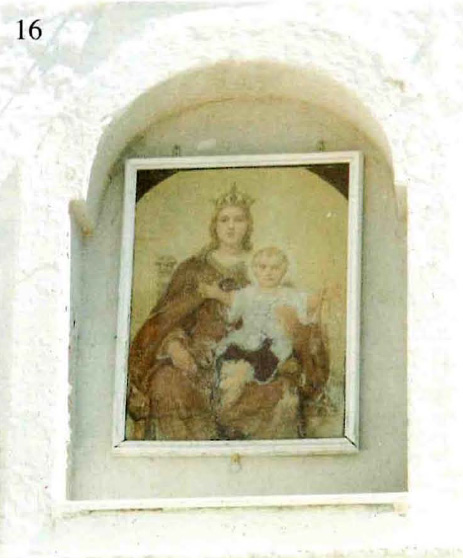
The Edicola votiva Madonna del Carmine, cataloged as number 16 in local heritage registers, is a traditional Italian votive shrine. These structures, often found embedded in the facades of historic buildings or positioned at street corners, served as essential points of communal devotion and navigation in pre-modern urban centers. This specific edicola houses an oil-on-canvas painting depicting the Madonna del Carmine, a significant iconographic representation of the Virgin Mary associated with the Carmelite Order.
Visitors interested in historical urban artifacts will find this site a poignant example of the intersection between private piety and public space. While these shrines are often overlooked by modern commuters, they offer a glimpse into the social fabric of historical Italian settlements, where religious imagery acted as a protective talisman for the community. For those planning their itinerary, exploring these small-scale heritage sites provides excellent trip ideas for understanding the layers of local history that define Italian streetscapes. Whether you are mapping out local attractions or simply wandering through the historic core, the Edicola votiva Madonna del Carmine serves as a quiet reminder of the artistic and spiritual traditions that have shaped the region for centuries. It is recommended to visit during the morning or early afternoon when natural light best illuminates the canvas protected within the shrine.
General information
The Edicola votiva Madonna del Carmine, cataloged as number 16 in local heritage registers, is a traditional Italian votive shrine. These structures, often found embedded in the facades of historic buildings or positioned at street corners, served as essential points of communal devotion and navigation in pre-modern urban centers. This specific edicola houses an oil-on-canvas painting depicting the Madonna del Carmine, a significant iconographic representation of the Virgin Mary associated with the Carmelite Order.
Visitors interested in historical urban artifacts will find this site a poignant example of the intersection between private piety and public space. While these shrines are often overlooked by modern commuters, they offer a glimpse into the social fabric of historical Italian settlements, where religious imagery acted as a protective talisman for the community. For those planning their itinerary, exploring these small-scale heritage sites provides excellent trip ideas for understanding the layers of local history that define Italian streetscapes. Whether you are mapping out local attractions or simply wandering through the historic core, the Edicola votiva Madonna del Carmine serves as a quiet reminder of the artistic and spiritual traditions that have shaped the region for centuries. It is recommended to visit during the morning or early afternoon when natural light best illuminates the canvas protected within the shrine.
Did you know
- Votive shrines like this were often commissioned by local guilds or wealthy families to provide protection to the neighborhood.
- The Madonna del Carmine is traditionally depicted wearing a brown scapular, a key identifier of the Carmelite Order.
- Many such edicole were once illuminated by small oil lamps, which were maintained by local residents as an act of service.
History
Votive shrines, or edicole, became prominent in Italy during the late Middle Ages and the Renaissance. They were established as focal points for the faithful who could not always access larger parish churches. The specific inclusion of the Madonna del Carmine points to the widespread influence of the Carmelite Order, which gained significant popularity across Italy between the 13th and 17th centuries. These shrines were frequently restored or repainted over the generations, reflecting the ongoing devotion of the local community. The presence of an oil-on-canvas work suggests a period of stylistic development where durable, portable art became common for outdoor placement.
Cultural significance
The cultural significance of the Edicola votiva Madonna del Carmine lies in its role as a 'living' monument. Historically, these shrines acted as social markers, creating a sense of identity and place within a neighborhood. By placing religious art in the public sphere, the community integrated their faith into the very architecture of their daily lives. Today, these sites are recognized as vital components of Italy's intangible cultural heritage, documenting the transition from medieval communal religious life to the modern urban experience. They remain symbols of local continuity and architectural history.
Geography and landscape
The Edicola votiva Madonna del Carmine is integrated into the urban fabric of a historic Italian town. These shrines are characteristically located at the intersection of narrow lanes or embedded directly into the masonry of residential or civic buildings. This placement was strategic, ensuring that the image was visible to passersby, thereby sanctifying the transit routes of the town. The landscape is defined by traditional stone or brick construction, reflecting the density of historic Italian urban centers. The shrine's exposure to the elements highlights the necessity of its protective alcove, which shields the artwork from direct weather.
More facts
- Imported from OSM batch
Visitor links
Nearby attractions
- Edicola votiva Madonna del Carmine e Anime Purganti 58 m
- Edicola votiva San Giovannino 58 m
- Edicola votiva San Biagio, Deposizione dalla Croce, Sant’Oronzo, Colomba dello Spirito Santo 68 m
- Edicola votiva Deposizione di Cristo 102 m
- Edicola votiva Madonna con Bambino 102 m
- Edicola votiva (Via Gaspare Petrarolo) 103 m
- Edicola votiva San Pasquale Baylon 106 m
- Edicola votiva Cuore di Gesù 113 m