Edicola votiva Cuore di Gesù
IT
- Location
- IT
- Category
- heritage historic sites
- Coordinates
- 40.7336324, 17.5794191
- Best time
- Morning or early afternoon
- Weather tip
- Check the local forecast before visiting.
Overview
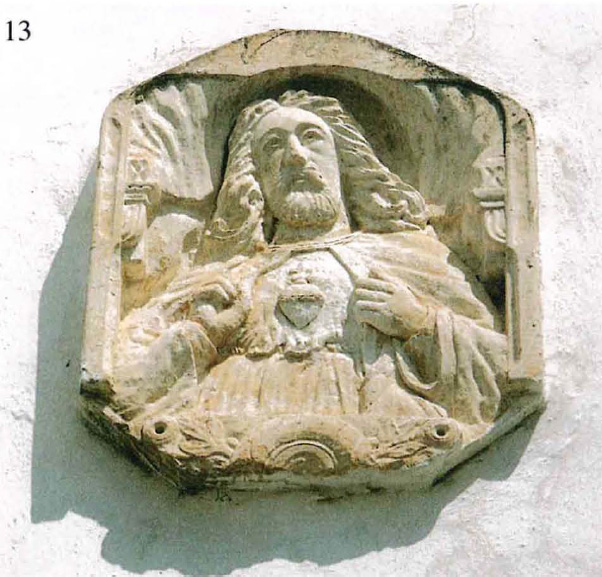
The Edicola Votiva Cuore di Gesù, cataloged as number 13, is a traditional Italian votive shrine featuring a half-bust sculpture of Jesus carved from stone. These small religious structures, known as 'edicole votive,' are quintessential elements of the Italian urban and rural landscape, often found at street corners, crossroads, or integrated into the façades of older buildings. They serve as a testament to the long-standing tradition of popular piety, marking spaces for devotion and reflection within the daily lives of local communities. For travelers exploring historical Italian neighborhoods, these modest shrines represent a fascinating category of heritage sites that offer a glimpse into the spiritual life of past centuries. While they may appear as simple decorative elements to the casual observer, they are significant markers of local identity and historical continuity. Visitors interested in authentic cultural experiences will find that seeking out these small monuments provides excellent inspiration for trip ideas, as they often lead to hidden corners of towns that remain untouched by modern development. As you navigate through historic centers, keeping an eye out for such architectural details is a rewarding way to discover the layers of history embedded in the city walls. Whether you are a student of religious art or simply a curious traveler, this stone representation of the Sacred Heart offers a quiet, contemplative pause amidst your exploration of local attractions.
General information
The Edicola Votiva Cuore di Gesù, cataloged as number 13, is a traditional Italian votive shrine featuring a half-bust sculpture of Jesus carved from stone. These small religious structures, known as 'edicole votive,' are quintessential elements of the Italian urban and rural landscape, often found at street corners, crossroads, or integrated into the façades of older buildings. They serve as a testament to the long-standing tradition of popular piety, marking spaces for devotion and reflection within the daily lives of local communities. For travelers exploring historical Italian neighborhoods, these modest shrines represent a fascinating category of heritage sites that offer a glimpse into the spiritual life of past centuries. While they may appear as simple decorative elements to the casual observer, they are significant markers of local identity and historical continuity. Visitors interested in authentic cultural experiences will find that seeking out these small monuments provides excellent inspiration for trip ideas, as they often lead to hidden corners of towns that remain untouched by modern development. As you navigate through historic centers, keeping an eye out for such architectural details is a rewarding way to discover the layers of history embedded in the city walls. Whether you are a student of religious art or simply a curious traveler, this stone representation of the Sacred Heart offers a quiet, contemplative pause amidst your exploration of local attractions.
Did you know
- Votive shrines like this were historically placed at crossroads to offer protection to travelers.
- The term 'edicola' derives from the Latin 'aedicula,' meaning a small house or temple.
- These shrines often served as the only source of street lighting in pre-modern Italian towns, as they were frequently accompanied by a small oil lamp.
History
Votive shrines became widespread in Italy during the post-Tridentine period, following the Council of Trent (1545–1563). The Catholic Church encouraged the placement of sacred images in public spaces to reinforce the faith of the populace and provide focal points for communal prayer. These structures were often commissioned by local guilds, wealthy families, or neighborhood associations as an expression of gratitude or a request for divine protection against plague, famine, or war. The stone bust of Jesus in this specific edicola reflects the stylistic conventions of regional artisans who specialized in religious iconography during the 18th and 19th centuries, emphasizing a direct, accessible connection between the divine and the urban environment.
Cultural significance
The Edicola Votiva Cuore di Gesù functions as a cultural bridge between private devotion and public space. Culturally, these shrines are significant because they humanize the urban landscape, transforming anonymous streets into meaningful places of shared heritage. They are frequently maintained by local residents, who may decorate them with fresh flowers or candles, ensuring that the tradition of popular piety remains a living practice rather than a static historical exhibit. This ongoing stewardship preserves the unique character of Italian neighborhoods, providing a sense of place that connects contemporary inhabitants with their ancestors who once sought solace before these very images.
Geography and landscape
The Edicola Votiva Cuore di Gesù is situated within the dense, historic urban fabric characteristic of traditional Italian settlements. These shrines are typically embedded into the masonry of older buildings or stand as independent structures at street intersections. Their placement is rarely accidental; they were historically positioned to be visible to pedestrians moving through the narrow, winding alleys that define the medieval or Renaissance layout of the town. The surrounding terrain is often paved with cobblestones or local stone, and the shrine itself is frequently sheltered by the architectural overhangs of adjacent structures, which protect the stone carving from the elements.
More facts
- Imported from OSM batch
Visitor links
Nearby attractions
- Edicola votiva Madonna con Bambino 18 m
- Edicola votiva Santi Medici 25 m
- Edicola votiva San Biagio, Deposizione dalla Croce, Sant’Oronzo, Colomba dello Spirito Santo 45 m
- Edicola votiva San Pasquale Baylon 45 m
- Edicola votiva Madonna della Stella 56 m
- Edicola votiva San Giovannino 57 m
- Edicola votiva (Via Pompeo Patrelli) 58 m
- Edicola votiva della Madonna del Carmine o di Sant’Oronzo (?) 70 m