Edicola votiva Maria Immacolata
IT
- Location
- IT
- Category
- heritage historic sites
- Coordinates
- 40.7308519, 17.5795911
- Best time
- Morning or early afternoon
- Weather tip
- Check the local forecast before visiting.
Overview
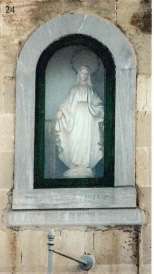
The Edicola votiva Maria Immacolata, cataloged as niche number 24, serves as a significant example of the devotional architecture that characterizes many Italian urban landscapes. This small, protected alcove houses a delicate statue crafted from painted plaster, depicting the Virgin Mary in her manifestation as the Immaculate Conception. These votive shrines, or 'edicole votive,' were historically established at street corners or integrated into the facades of residential buildings to provide spiritual protection and guidance to the local community. Visitors interested in exploring the layers of history embedded in everyday architecture will find this site a poignant reminder of popular religious devotion. When considering what to do in the area, observing these minor monuments provides a unique perspective on the intersection of art, faith, and public space. The statue itself represents a traditional iconographic style, preserved within its niche to maintain its visibility for passersby. While modest in size, the edicola acts as a tangible link to the social and religious customs of the past. It is recommended to visit during the morning or early afternoon to take full advantage of natural light, which illuminates the details of the painted plasterwork. As part of a broader set of local attractions, this site invites reflection on the preservation of small-scale heritage elements that define the character of Italian streets.
General information
The Edicola votiva Maria Immacolata, cataloged as niche number 24, serves as a significant example of the devotional architecture that characterizes many Italian urban landscapes. This small, protected alcove houses a delicate statue crafted from painted plaster, depicting the Virgin Mary in her manifestation as the Immaculate Conception. These votive shrines, or 'edicole votive,' were historically established at street corners or integrated into the facades of residential buildings to provide spiritual protection and guidance to the local community. Visitors interested in exploring the layers of history embedded in everyday architecture will find this site a poignant reminder of popular religious devotion. When considering what to do in the area, observing these minor monuments provides a unique perspective on the intersection of art, faith, and public space. The statue itself represents a traditional iconographic style, preserved within its niche to maintain its visibility for passersby. While modest in size, the edicola acts as a tangible link to the social and religious customs of the past. It is recommended to visit during the morning or early afternoon to take full advantage of natural light, which illuminates the details of the painted plasterwork. As part of a broader set of local attractions, this site invites reflection on the preservation of small-scale heritage elements that define the character of Italian streets.
Did you know
- The term 'edicola' derives from the Latin 'aedicula,' meaning a small shrine or temple.
- Votive niches were often commissioned by local families or guilds to offer protection to travelers and residents.
- Painted plaster was a common, affordable material used for devotional statues in the 19th and early 20th centuries.
History
The history of the Edicola votiva Maria Immacolata is rooted in the long-standing Italian tradition of erecting street-side shrines. These structures became prominent in urban centers as focal points for communal prayer and public piety. While the specific date of the installation of niche number 24 is not documented, such shrines were frequently established during periods of heightened religious fervor or as part of neighborhood urban development projects. They served as vital markers in the city, acting as navigational aids and spiritual anchors for the inhabitants. The use of painted plaster suggests a creation period consistent with the widespread distribution of devotional art in the late 19th or early 20th centuries, reflecting the aesthetic preferences of the time.
Cultural significance
These shrines represent an essential aspect of Italian folk culture, where the sacred was integrated directly into the secular urban environment. The Immaculate Conception, represented here, holds a central place in Catholic devotion, and the placement of her image at a street corner highlights the belief that the divine presence was meant to be accessible to all, not just within the confines of a church. The maintenance of these edicole often fell to local residents, fostering a sense of community responsibility and shared heritage. Today, they serve as quiet witnesses to the changing social fabric of the city, preserving a tangible connection to the spiritual life of previous generations.
Geography and landscape
The Edicola votiva Maria Immacolata is situated within an urban context, typical of the dense, historic architectural layouts found in many Italian towns. Positioned as a niche within a building facade, it is an integral part of the streetscape, designed to be viewed by pedestrians at eye level. Its location at a corner or along a thoroughfare allows it to interact with the daily flow of the neighborhood. The environment is characterized by traditional masonry, often featuring narrow streets and stone or brick facades that provide a stark, historical backdrop for the vibrant, painted colors of the statue within the alcove.
More facts
- Imported from OSM batch
Visitor links
Nearby attractions
- Edicola votiva (Via Cesare Beccaria) 49 m
- Edicola votiva Madonna del Carmine 54 m
- Edicola votiva Madonna del Carmine e San Simone Stock 67 m
- Edicola votiva Madonna della Grata 120 m
- Edicola votiva Immacolata 132 m
- Edicola votiva Cristo spirante 137 m
- Edicola votiva Immacolata 143 m
- Edicola votiva Cuore di Gesù 151 m