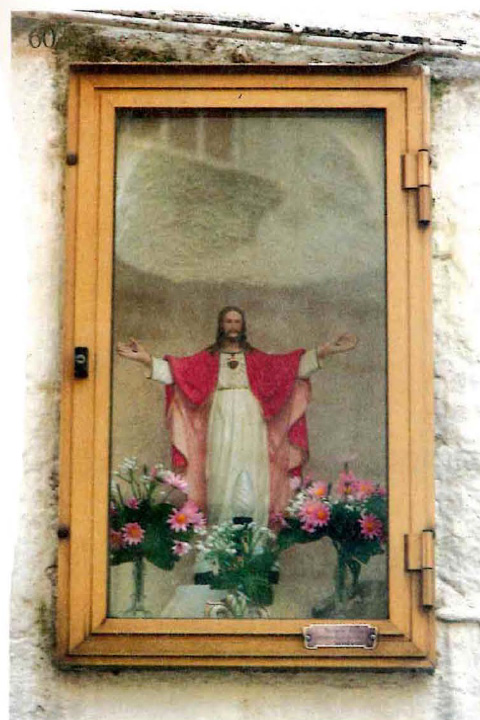
Edicola votiva Cuore di Gesù
IT
- Location
- IT
- Category
- heritage historic sites
- Coordinates
- 40.7310902, 17.5745373
- Best time
- Morning or early afternoon
- Weather tip
- Check the local forecast before visiting.
Overview
The Edicola votiva Cuore di Gesù, identified as niche number 60, is a traditional votive shrine containing a painted plaster statue dedicated to the Sacred Heart of Jesus. These street-side shrines, or edicole, are a characteristic element of Italian urban heritage, serving as historical markers of popular devotion and communal religious expression. Visitors interested in the architectural history of Italian neighborhoods will find these small, often overlooked monuments to be essential stops when exploring the hidden layers of local history. As you walk through the area, these shrines offer a glimpse into the social and spiritual life of past centuries, where such installations functioned as focal points for neighborhood prayers and collective identity. If you are looking for unique trip ideas, these votive sites provide a quiet, reflective alternative to larger tourist attractions. They represent a tangible connection to the cultural fabric of Italy, standing as silent witnesses to the passage of time. While they may be small in stature, their presence is significant for understanding local traditions and the evolution of urban religious art. Whether you are an avid history enthusiast or simply curious about the details that define Italian streets, the Edicola votiva Cuore di Gesù serves as a fascinating example of how faith and art have historically intersected in public spaces. It is a perfect point of interest for those planning a walking tour focused on authentic, localized heritage.
General information
The Edicola votiva Cuore di Gesù, identified as niche number 60, is a traditional votive shrine containing a painted plaster statue dedicated to the Sacred Heart of Jesus. These street-side shrines, or edicole, are a characteristic element of Italian urban heritage, serving as historical markers of popular devotion and communal religious expression. Visitors interested in the architectural history of Italian neighborhoods will find these small, often overlooked monuments to be essential stops when exploring the hidden layers of local history. As you walk through the area, these shrines offer a glimpse into the social and spiritual life of past centuries, where such installations functioned as focal points for neighborhood prayers and collective identity. If you are looking for unique trip ideas, these votive sites provide a quiet, reflective alternative to larger tourist attractions. They represent a tangible connection to the cultural fabric of Italy, standing as silent witnesses to the passage of time. While they may be small in stature, their presence is significant for understanding local traditions and the evolution of urban religious art. Whether you are an avid history enthusiast or simply curious about the details that define Italian streets, the Edicola votiva Cuore di Gesù serves as a fascinating example of how faith and art have historically intersected in public spaces. It is a perfect point of interest for those planning a walking tour focused on authentic, localized heritage.
Did you know
- The term 'edicola' refers to a small shrine or niche, often built into the exterior walls of buildings.
- Votive shrines were traditionally commissioned by local residents as an act of faith or gratitude.
- The Sacred Heart of Jesus is a common subject in Italian devotional art, symbolizing divine love.
History
The history of the Edicola votiva Cuore di Gesù is rooted in the long-standing Italian tradition of placing religious imagery in public spaces. These shrines were typically installed between the 18th and early 20th centuries to provide a sense of protection and spiritual comfort to the local community. The use of painted plaster statues became widespread during this period due to their affordability and durability in outdoor settings. The niche itself, designated as number 60, suggests it was part of a larger, documented catalog of public religious monuments within its specific urban context. These structures were often maintained by local guilds, neighborhood associations, or the residents of the buildings upon which they were mounted, ensuring their preservation through generations.
Cultural significance
Culturally, the Edicola votiva Cuore di Gesù represents the intersection of public life and private devotion. In historical Italian society, these shrines functioned as 'outdoor altars' where residents would stop to pray, light candles, or leave flowers during their daily commute. They served as vital social anchors, helping to define the identity of a neighborhood and providing a common visual language of faith. Today, they are recognized as important cultural assets that preserve the memory of historical religious practices. By maintaining these sites, local communities honor the traditions of their ancestors and protect a unique, modest form of artistic expression that is deeply ingrained in the Italian landscape.
Geography and landscape
The Edicola votiva Cuore di Gesù is situated within an urban environment, integrated directly into the architectural fabric of the city. As a niche shrine, it is physically embedded into the facade of a building, typical of how these structures were designed to be visible to passersby on narrow streets or alleyways. This placement highlights the density and historical layering of the urban landscape, where religious landmarks are woven into the living space of the city. The surrounding area is characterized by traditional building styles, providing a historical backdrop that complements the modest, devotional nature of the shrine itself.
More facts
- Imported from OSM batch
Visitor links
Nearby attractions
- Edicola votiva San Biagio, Madonna del Carmine, Sant’Oronzo, Colomba dello Spirito Santo 89 m
- Edicola votiva Cuore di Gesù 134 m
- Immacolata 135 m
- Edicola votiva Crocifissione 139 m
- Edicola votiva Cristo spirante 143 m
- Edicola votiva Immacolata 213 m
- Edicola votiva Santi Medici 226 m
- Edicola votiva San Biagio, Madonna del Carmine, Sant’Oronzo, Colomba dello Spirito Santo 232 m