Edicola votiva Cuore di Gesù
IT
- Location
- IT
- Category
- heritage historic sites
- Coordinates
- 40.7299037, 17.5748512
- Best time
- Morning or early afternoon
- Weather tip
- Check the local forecast before visiting.
Overview
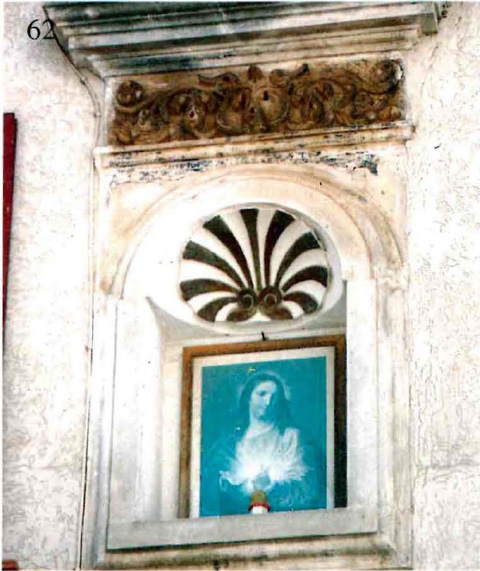
The Edicola votiva Cuore di Gesù, located within niche number 62, serves as a poignant example of Italian devotional heritage. These street-side shrines, or 'edicole votive,' have historically functioned as focal points for communal piety and local identity, often embedded directly into the urban fabric of Italian towns and cities. The centerpiece of this specific shrine is a four-color lithograph depicting the Sacred Heart of Jesus, a popular iconographic representation in Catholic tradition that emphasizes the divine love of Christ. Visitors observing this site will encounter a preserved piece of traditional religious art that offers a quiet moment of reflection amidst the daily rhythm of the street. Such shrines are essential elements when considering what to do in the area for those interested in the layers of history that define Italian streetscapes. While often overlooked by casual passersby, these sites provide significant insight into the social and religious customs of previous generations. For travelers seeking authentic trip ideas that go beyond major monuments, the Edicola votiva Cuore di Gesù represents the intimate, neighborhood-level history that characterizes the Italian landscape. The lithograph itself serves as a testament to the accessibility of religious imagery in the 19th and early 20th centuries, when such prints became widely distributed, allowing families to establish personal or collective sacred spaces within the public sphere.
General information
The Edicola votiva Cuore di Gesù, located within niche number 62, serves as a poignant example of Italian devotional heritage. These street-side shrines, or 'edicole votive,' have historically functioned as focal points for communal piety and local identity, often embedded directly into the urban fabric of Italian towns and cities. The centerpiece of this specific shrine is a four-color lithograph depicting the Sacred Heart of Jesus, a popular iconographic representation in Catholic tradition that emphasizes the divine love of Christ. Visitors observing this site will encounter a preserved piece of traditional religious art that offers a quiet moment of reflection amidst the daily rhythm of the street. Such shrines are essential elements when considering what to do in the area for those interested in the layers of history that define Italian streetscapes. While often overlooked by casual passersby, these sites provide significant insight into the social and religious customs of previous generations. For travelers seeking authentic trip ideas that go beyond major monuments, the Edicola votiva Cuore di Gesù represents the intimate, neighborhood-level history that characterizes the Italian landscape. The lithograph itself serves as a testament to the accessibility of religious imagery in the 19th and early 20th centuries, when such prints became widely distributed, allowing families to establish personal or collective sacred spaces within the public sphere.
Did you know
- Edicole votive often served as unofficial street lighting in the past, as the faithful would keep candles burning before the images at night.
- The use of four-color lithography became a standard method for mass-producing religious icons in the late 19th century.
- The Sacred Heart of Jesus is one of the most widely practiced devotions in the Roman Catholic Church.
History
The tradition of the 'edicola votiva' dates back centuries, rooted in the desire to sanctify public spaces. These structures were often commissioned by local guilds, neighborhood associations, or wealthy families as expressions of gratitude or protection. The specific use of a four-color lithograph in this niche suggests a date of origin likely spanning the late 19th to early 20th centuries, a period when technological advancements in printing made high-quality, durable religious imagery affordable and accessible for public display in urban niches.
Cultural significance
These shrines act as an 'open-air museum' of popular faith. They represent the intersection of private devotion and public life, where the sacred is brought into the everyday paths of the citizenry. The Sacred Heart of Jesus image specifically reflects a period of intense theological focus on the humanity and compassion of Christ, which deeply influenced Italian social and family life. These sites maintain a sense of continuity, linking contemporary urban dwellers to the spiritual preoccupations of their ancestors.
Geography and landscape
The Edicola votiva Cuore di Gesù is an integrated architectural element, typical of historic Italian urban environments. It is set within a niche—a recessed cavity in a wall—which protects the artwork from the elements while ensuring it remains visible to pedestrians. These shrines are usually found at street corners or near building entrances, serving as silent witnesses to the evolving architecture and traffic patterns of the surrounding neighborhood.
More facts
- Imported from OSM batch
Visitor links
Nearby attractions
- Edicola votiva Immacolata 114 m
- Edicola votiva Cuore di Gesù 134 m
- Edicola votiva San Biagio, Madonna del Carmine e Anime Purganti, Sant’Oronzo, Colomba dello Spirito Santo 139 m
- Edicola votiva Crocifissione 143 m
- Edicola votiva Deposizione dalla Croce 166 m
- Edicola votiva San Biagio, Madonna del Carmine, Sant’Oronzo, Colomba dello Spirito Santo 176 m
- Immacolata 194 m
- Edicola votiva San Biagio, Madonna del Carmine, Sant’Oronzo, Colomba dello Spirito Santo 209 m