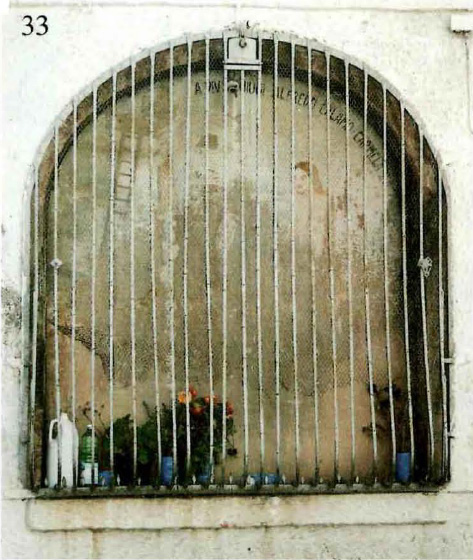
Edicola votiva Deposizione dalla Croce
IT
- Location
- IT
- Category
- heritage historic sites
- Coordinates
- 40.7290263, 17.576442
- Best time
- Morning or early afternoon
- Weather tip
- Check the local forecast before visiting.
Overview
The Edicola votiva Deposizione dalla Croce, designated as niche number 33, is a significant piece of devotional heritage found in Italy. This structure houses a tempera grassa painting on wood depicting the Deposition from the Cross, a scene capturing the moment Christ is removed from the cross after his crucifixion. Locally and traditionally referred to as “Il Crocifisso,” this votive image serves as a profound example of the religious art integrated into the urban fabric of Italian towns. Visitors interested in historical religious iconography will find this site a compelling stop while exploring local attractions. The preservation of such niche paintings offers a unique window into the spiritual life and artistic expressions of past centuries. When planning your visit, it is recommended to stop by during the morning or early afternoon to take advantage of the natural light, which enhances the visibility of the tempera details. As you consider various trip ideas for your Italian itinerary, this site provides a quiet moment of historical reflection, characteristic of the many hidden gems that define the country's cultural landscape. The niche remains an essential point of interest for those documenting the intersection of local piety and traditional craftsmanship.
General information
The Edicola votiva Deposizione dalla Croce, designated as niche number 33, is a significant piece of devotional heritage found in Italy. This structure houses a tempera grassa painting on wood depicting the Deposition from the Cross, a scene capturing the moment Christ is removed from the cross after his crucifixion. Locally and traditionally referred to as “Il Crocifisso,” this votive image serves as a profound example of the religious art integrated into the urban fabric of Italian towns. Visitors interested in historical religious iconography will find this site a compelling stop while exploring local attractions. The preservation of such niche paintings offers a unique window into the spiritual life and artistic expressions of past centuries. When planning your visit, it is recommended to stop by during the morning or early afternoon to take advantage of the natural light, which enhances the visibility of the tempera details. As you consider various trip ideas for your Italian itinerary, this site provides a quiet moment of historical reflection, characteristic of the many hidden gems that define the country's cultural landscape. The niche remains an essential point of interest for those documenting the intersection of local piety and traditional craftsmanship.
Did you know
- The painting is executed in 'tempera grassa,' a technique that incorporates oil or varnish into the traditional egg-based tempera medium to increase saturation and durability.
- The niche is officially cataloged as number 33 within its local administrative or historical survey.
- Despite the name 'Deposizione' (Deposition), the local population commonly refers to the site simply as 'Il Crocifisso'.
History
The Edicola votiva Deposizione dalla Croce belongs to a long-standing Italian tradition of street-side shrines. These structures were historically commissioned by private citizens, confraternities, or local guilds to provide spaces for public devotion in the urban landscape. The use of tempera grassa suggests a period where artistic techniques were evolving to better withstand the elements of an outdoor environment. While the specific date of origin for this niche is not documented in the provided source, such votive edicole typically date from the 17th to the 19th centuries, reflecting a peak in Counter-Reformation piety and the desire to bring sacred imagery directly into the daily lives of the populace.
Cultural significance
This niche represents the intersection of high art and popular religion. By placing a depiction of the Deposition from the Cross in a public thoroughfare, the creators ensured that the sacred narrative was accessible to all, regardless of social status. The local moniker 'Il Crocifisso' demonstrates how these sites became landmarks within the community's collective memory, often serving as points for prayer or as markers for navigating the city. The preservation of such sites is vital for understanding the historical continuity of Catholic traditions in Italy, where the boundary between the sacred and the secular is often blurred by the presence of art in everyday spaces.
Geography and landscape
The niche is situated as an integrated element of the built environment, likely embedded within the wall of a building or a boundary structure. It is designed to be viewed from the street, functioning as an outdoor gallery that punctuates the pedestrian experience. Its placement is typical of Italian urban architecture, where religious icons are frequently incorporated into the facades of homes or public buildings to sanctify the space. The surrounding landscape is defined by the dense, historical urban fabric characteristic of Italian centers, where the interaction between historical preservation and modern life is constant.
More facts
- Imported from OSM batch
Visitor links
Nearby attractions
- Edicola votiva San Biagio, Madonna del Carmine e Anime Purganti, Sant’Oronzo, Colomba dello Spirito Santo 31 m
- Edicola votiva Immacolata 69 m
- Edicola votiva San Biagio, Madonna del Carmine, Sant’Oronzo, Colomba dello Spirito Santo 104 m
- Edicola votiva Cuore di Gesù 166 m
- Edicola votiva San Biagio, Madonna del Carmine, Sant’Oronzo, Colomba dello Spirito Santo 179 m
- Edicola votiva Crocifissione 194 m
- Edicola votiva Madonna della Grata 237 m
- Edicola votiva Santi Medici 262 m