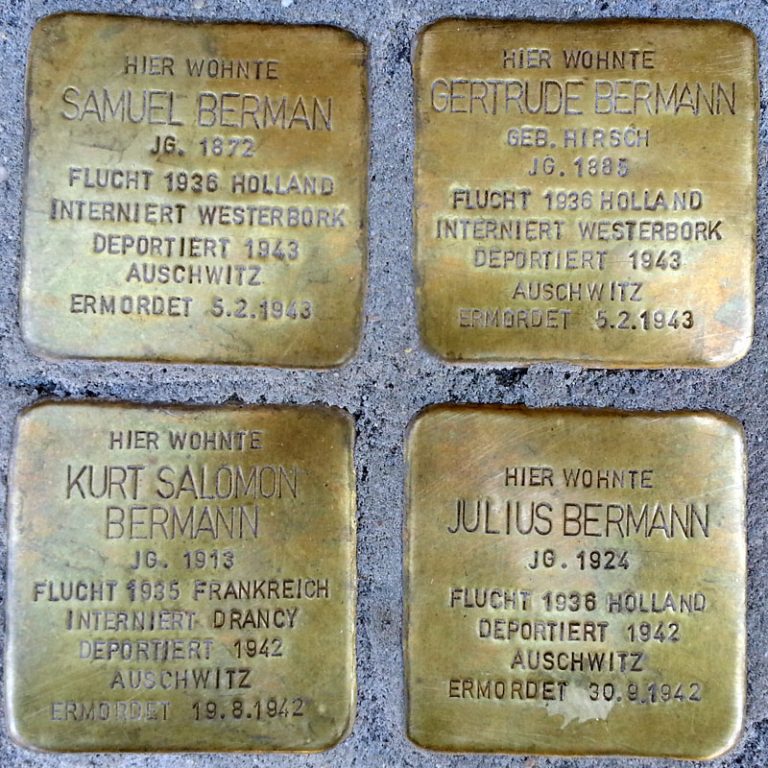
Gertrude Bermann geb. Hirsch
DE
- Location
- DE
- Category
- heritage historic sites
- Coordinates
- 49.2220588, 6.8088665
- Best time
- Morning or early afternoon
- Weather tip
- Check the local forecast before visiting.
Overview
Gertrude Bermann, born Hirsch, is commemorated through a Stolperstein, or 'stumbling stone,' located in Völklingen, Germany. These brass-plated cobblestones are part of a decentralized memorial project initiated by artist Gunter Demnig to honor victims of the National Socialist regime. Each stone is embedded in the pavement in front of the last place of residence of a victim who was persecuted, deported, or murdered under the Nazi dictatorship. Visitors to Völklingen often seek out these markers as part of a somber, reflective tour of the city’s history. By documenting the names and fates of individuals like Gertrude Bermann, these sites serve as a poignant reminder of the human cost of the Holocaust. For those interested in local heritage and historical remembrance, these markers offer a profound way to connect with the personal stories behind the statistics. When planning your trip ideas in the region, including a stop at these memorial sites provides a deeper understanding of the local impact of the Third Reich. The stones are integrated into the urban fabric, allowing for quiet contemplation amidst daily life. As you explore the city, observing these markers is a meaningful way to engage with the historical narrative of the community, ensuring that the lives of those targeted are not forgotten.
General information
Gertrude Bermann, born Hirsch, is commemorated through a Stolperstein, or 'stumbling stone,' located in Völklingen, Germany. These brass-plated cobblestones are part of a decentralized memorial project initiated by artist Gunter Demnig to honor victims of the National Socialist regime. Each stone is embedded in the pavement in front of the last place of residence of a victim who was persecuted, deported, or murdered under the Nazi dictatorship. Visitors to Völklingen often seek out these markers as part of a somber, reflective tour of the city’s history. By documenting the names and fates of individuals like Gertrude Bermann, these sites serve as a poignant reminder of the human cost of the Holocaust. For those interested in local heritage and historical remembrance, these markers offer a profound way to connect with the personal stories behind the statistics. When planning your trip ideas in the region, including a stop at these memorial sites provides a deeper understanding of the local impact of the Third Reich. The stones are integrated into the urban fabric, allowing for quiet contemplation amidst daily life. As you explore the city, observing these markers is a meaningful way to engage with the historical narrative of the community, ensuring that the lives of those targeted are not forgotten.
Did you know
- The 'Stolpersteine' project is considered the world's largest decentralized memorial.
- Each stone is hand-crafted and inscribed by hand before being set into the pavement.
- The name 'Stolperstein' literally translates to 'stumbling stone,' meant to make people 'stumble' with their minds rather than their feet.
History
The Stolperstein dedicated to Gertrude Bermann, born Hirsch, serves as a historical record of her life and persecution. These stones are placed to acknowledge the specific address where individuals resided before they were forced to flee or were deported by the Nazi regime. In Völklingen, as in many other German cities, these markers represent the systematic effort to strip Jewish citizens and other persecuted groups of their homes, livelihoods, and eventually their lives. By marking the physical site of her former residence, the stone restores a specific historical identity to the victim, counteracting the anonymity sought by the perpetrators of the Holocaust.
Cultural significance
The cultural significance of the Stolperstein project lies in its approach to 'Gedenkkultur,' or culture of remembrance. Unlike large, centralized monuments, these stones bring the history of the Holocaust directly into the public space of the living city. They force a confrontation with the past in the midst of the present, encouraging passersby to pause and acknowledge the history of their own neighborhoods. Gertrude Bermann’s stone is a testament to the local community's commitment to acknowledging and preserving the memory of those who were once their neighbors, neighbors who were targeted and removed during a dark chapter of German history.
Geography and landscape
The Stolperstein for Gertrude Bermann is situated within the urban landscape of Völklingen. These memorials are not isolated in a park or museum but are embedded directly into the sidewalks and streets of the city. Because they are located at the site of former private residences, they are integrated into the everyday environment, surrounded by the modern infrastructure, homes, and businesses of the town. This placement is intentional, ensuring that the history of the Holocaust remains a visible, unavoidable part of the contemporary urban topography.
More facts
- Imported from OSM batch
Visitor links
Nearby attractions
- Samuel Bermann 1 m
- Wilhelm Bermann 125 m
- Kanalstollen 3273 m
- Zwangsarbeiter-Stolperschwelle 3984 m
- Robert Kahn 4529 m
- Tagesstrecke C 4669 m
- Abraham Kaiser 4717 m
- Fritz Lieser 5092 m