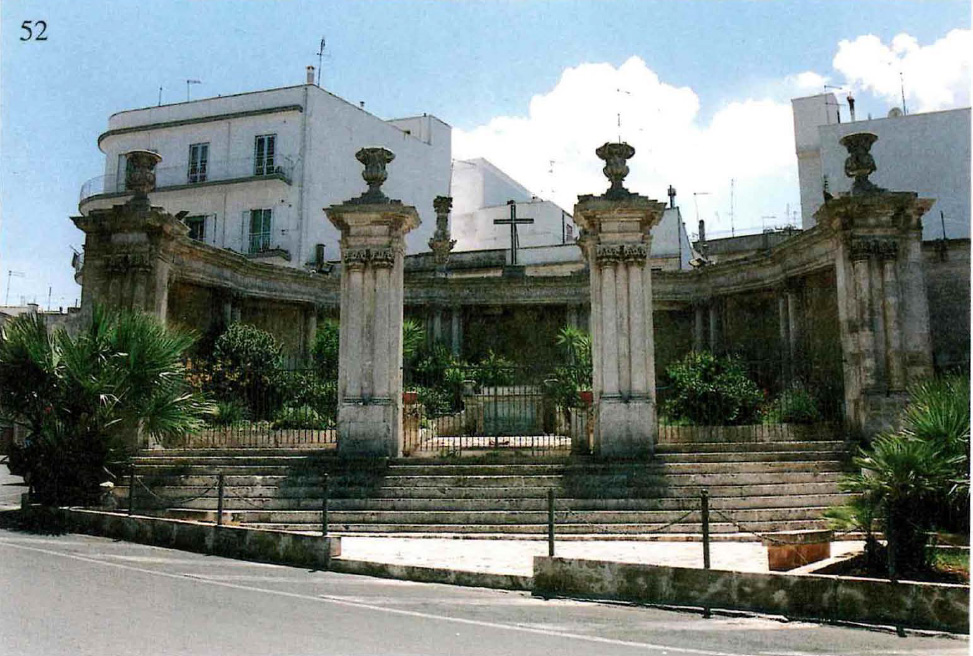
Edicola votiva Scene della Passione (il Calvario)
IT
- Location
- IT
- Category
- heritage historic sites
- Coordinates
- 40.7276613, 17.579666
- Best time
- Morning or early afternoon
- Weather tip
- Check the local forecast before visiting.
Overview
The Edicola votiva, known as 'Il Calvario' (No. 50), is a significant example of religious vernacular art in Italy. These small, street-side shrines served as vital points of devotion for local communities, often marking pathways or crossroads. This specific edicola is distinguished by its cycle of seven episodes depicting the Passion of Christ, rendered in tempera on plaster. Visitors who appreciate historical religious iconography will find this site a compelling study in regional devotional traditions. While small in scale, the work provides a direct window into the spiritual life and artistic expressions of the period in which it was commissioned. As you explore local attractions, consider that such votive shrines are often tucked away in historic urban centers or along rural paths, offering a quiet moment of reflection. When planning your trip ideas for exploring Italian heritage, these minor monuments are essential for understanding the widespread influence of the Catholic faith on daily life. Each of the seven painted scenes serves as a narrative sequence, guiding the observer through the final events of the Passion. The preservation of these tempera paintings remains a testament to the dedication of local caretakers. For those seeking authentic cultural depth, visiting these shrines is a rewarding way to discover the hidden artistic layers of the Italian landscape.
General information
The Edicola votiva, known as 'Il Calvario' (No. 50), is a significant example of religious vernacular art in Italy. These small, street-side shrines served as vital points of devotion for local communities, often marking pathways or crossroads. This specific edicola is distinguished by its cycle of seven episodes depicting the Passion of Christ, rendered in tempera on plaster. Visitors who appreciate historical religious iconography will find this site a compelling study in regional devotional traditions. While small in scale, the work provides a direct window into the spiritual life and artistic expressions of the period in which it was commissioned. As you explore local attractions, consider that such votive shrines are often tucked away in historic urban centers or along rural paths, offering a quiet moment of reflection. When planning your trip ideas for exploring Italian heritage, these minor monuments are essential for understanding the widespread influence of the Catholic faith on daily life. Each of the seven painted scenes serves as a narrative sequence, guiding the observer through the final events of the Passion. The preservation of these tempera paintings remains a testament to the dedication of local caretakers. For those seeking authentic cultural depth, visiting these shrines is a rewarding way to discover the hidden artistic layers of the Italian landscape.
Did you know
- The shrine is formally cataloged as 'No. 50' in local heritage surveys.
- The paintings are executed in tempera, a permanent, fast-drying painting medium consisting of colored pigments mixed with a binder.
- The decorative cycle consists of exactly seven distinct episodes from the Passion of Christ.
History
Votive shrines like Il Calvario were typically commissioned by wealthy families, religious brotherhoods, or local communities between the 17th and 19th centuries. They were strategically placed to encourage prayer during daily commutes or to mark specific religious processions. The use of tempera on plaster was a common, cost-effective method for local artists to create didactic religious cycles that were accessible to the public. These structures were maintained through the centuries by local residents, who viewed them as essential protective icons for the neighborhood. While the specific date of origin for this shrine is not documented in the provided records, its architectural style and artistic technique are consistent with traditional Italian devotional architecture.
Cultural significance
Il Calvario serves as a vital piece of Italy's intangible cultural heritage. It represents the intersection of private piety and public space, acting as a visual sermon for a largely illiterate population in centuries past. The cycle of the Passion of Christ is a recurring theme in Italian art, intended to evoke empathy and reflection on the suffering of Christ. By maintaining these shrines, communities have historically reinforced their social cohesion and shared religious identity. Today, these sites are recognized not only for their religious function but as essential historical artifacts that document the evolution of folk art and the socio-religious history of the region.
Geography and landscape
Il Calvario is situated as an edicola votiva, meaning it is integrated into the built environment rather than standing as a separate building. These structures are typically found embedded into the exterior walls of houses, at the corners of narrow streets, or at the intersection of rural paths. Its physical setting is intimate, requiring the viewer to stop and observe the details at close range. The surrounding landscape is characterized by the traditional urban or rural fabric of the Italian countryside, where the proximity of the shrine to the street emphasizes its role as a constant, silent participant in the daily life of the community.
More facts
- Imported from OSM batch
Visitor links
Nearby attractions
- Edicola votiva (Largo Banchieri) 102 m
- Edicola votiva Madonna con Bambino 125 m
- Edicola votiva Immacolata 191 m
- Edicola votiva (Via Gabriele Rossetti) 221 m
- Edicola votiva Sant’Oronzo (?), Madonna del Carmine, San Francesco di Paola, Colomba dello Spirito Santo 235 m
- Edicola votiva (Via Alfonso Pomes) 266 m
- Immacolata 266 m
- Edicola votiva Cuore di Gesù 271 m