Edicola votiva Immacolata
IT
- Location
- IT
- Category
- heritage historic sites
- Coordinates
- 40.7263035, 17.5810588
- Best time
- Morning or early afternoon
- Weather tip
- Check the local forecast before visiting.
Overview
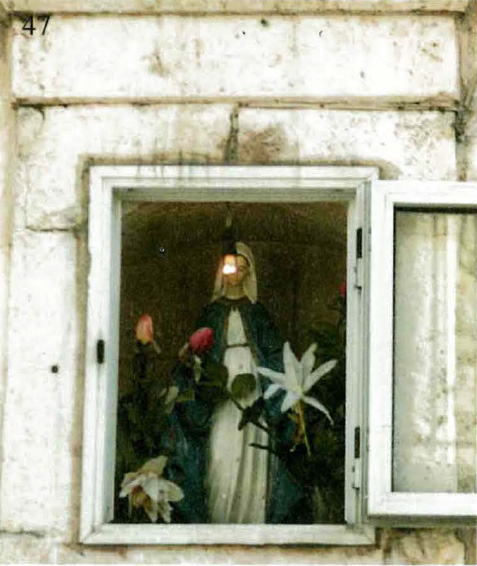
The Edicola votiva Immacolata, identified as niche number 47, is a traditional votive shrine serving as a significant example of religious folk art in Italy. These small, street-side shrines were historically constructed to provide a focal point for public devotion and to offer protection to the local community. The centerpiece of this specific niche is a finely crafted, painted terracotta statue depicting the Immaculate Conception. As visitors explore the historical urban fabric of Italian towns, they often encounter these quiet, artistic expressions of faith integrated directly into the architecture of private homes and public walls. Observing these shrines provides unique insight into the social and religious customs of past centuries, where such iconography served as a constant companion to the daily lives of residents. For those interested in discovering hidden local attractions, this niche offers a glimpse into the vernacular artistic traditions that define the character of the region. Visitors can expect to find a well-preserved piece of devotional heritage that invites a moment of quiet reflection amidst their travels. Whether you are planning your trip ideas or simply wandering through the historic streets, the Edicola votiva Immacolata stands as a testament to the enduring influence of religious iconography in the Italian landscape.
General information
The Edicola votiva Immacolata, identified as niche number 47, is a traditional votive shrine serving as a significant example of religious folk art in Italy. These small, street-side shrines were historically constructed to provide a focal point for public devotion and to offer protection to the local community. The centerpiece of this specific niche is a finely crafted, painted terracotta statue depicting the Immaculate Conception. As visitors explore the historical urban fabric of Italian towns, they often encounter these quiet, artistic expressions of faith integrated directly into the architecture of private homes and public walls. Observing these shrines provides unique insight into the social and religious customs of past centuries, where such iconography served as a constant companion to the daily lives of residents. For those interested in discovering hidden local attractions, this niche offers a glimpse into the vernacular artistic traditions that define the character of the region. Visitors can expect to find a well-preserved piece of devotional heritage that invites a moment of quiet reflection amidst their travels. Whether you are planning your trip ideas or simply wandering through the historic streets, the Edicola votiva Immacolata stands as a testament to the enduring influence of religious iconography in the Italian landscape.
Did you know
- The term 'edicola' refers to a small shrine or niche, often built into the wall of a building to house a sacred image.
- Terracotta, the material used for the statue, has been a preferred medium for Italian devotional art for centuries due to its durability and ease of modeling.
- Votive niches were historically maintained by local neighbors, who would often decorate them with flowers or candles.
History
The history of votive niches in Italy dates back to the late Middle Ages and the Renaissance, gaining significant popularity during the Counter-Reformation. These shrines were commissioned by private citizens or religious brotherhoods as acts of piety and public witness. The Edicola votiva Immacolata represents this long-standing tradition of placing sacred images in public view to sanctify the streetscape. While the specific date of this niche's construction is not documented, its style and material are consistent with the devotional artifacts frequently installed in urban centers across the Italian peninsula between the 18th and 19th centuries.
Cultural significance
Votive shrines are essential components of Italy's intangible cultural heritage. They represent the intersection of private faith and public space, acting as landmarks that provided spiritual comfort to passersby. The image of the Immaculate Conception, characterized by the Virgin Mary standing atop a globe or crescent moon, was a ubiquitous symbol of purity and intercession. By preserving such niches, the community maintains a tangible link to the devotional practices that shaped the social cohesion of historical neighborhoods. They remain important markers of local identity and cultural continuity.
Geography and landscape
The Edicola votiva Immacolata is integrated into the built environment, typically found embedded within the masonry of a historic structure. These shrines are usually positioned at eye level or slightly above, allowing them to be easily viewed by pedestrians navigating narrow streets or alleyways. Their placement is strategic, often situated at corners or along main thoroughfares to maximize visibility. The surrounding landscape is characterized by dense, historic urban architecture, where the niche serves as a decorative and spiritual interruption to the continuity of the street wall.
More facts
- Imported from OSM batch
Visitor links
Nearby attractions
- Immacolata 84 m
- Edicola votiva Madonna con Bambino 101 m
- Edicola votiva (Via Gabriele Rossetti) 107 m
- Edicola votiva (Largo Banchieri) 109 m
- Edicola votiva Scene della Passione (il Calvario) 191 m
- Edicola votiva Sant’Oronzo (?), Madonna del Carmine, San Francesco di Paola, Colomba dello Spirito Santo 329 m
- Edicola votiva (Corso Vittorio Emanuele II) 344 m
- Edicola votiva (Via Alfonso Pomes) 396 m