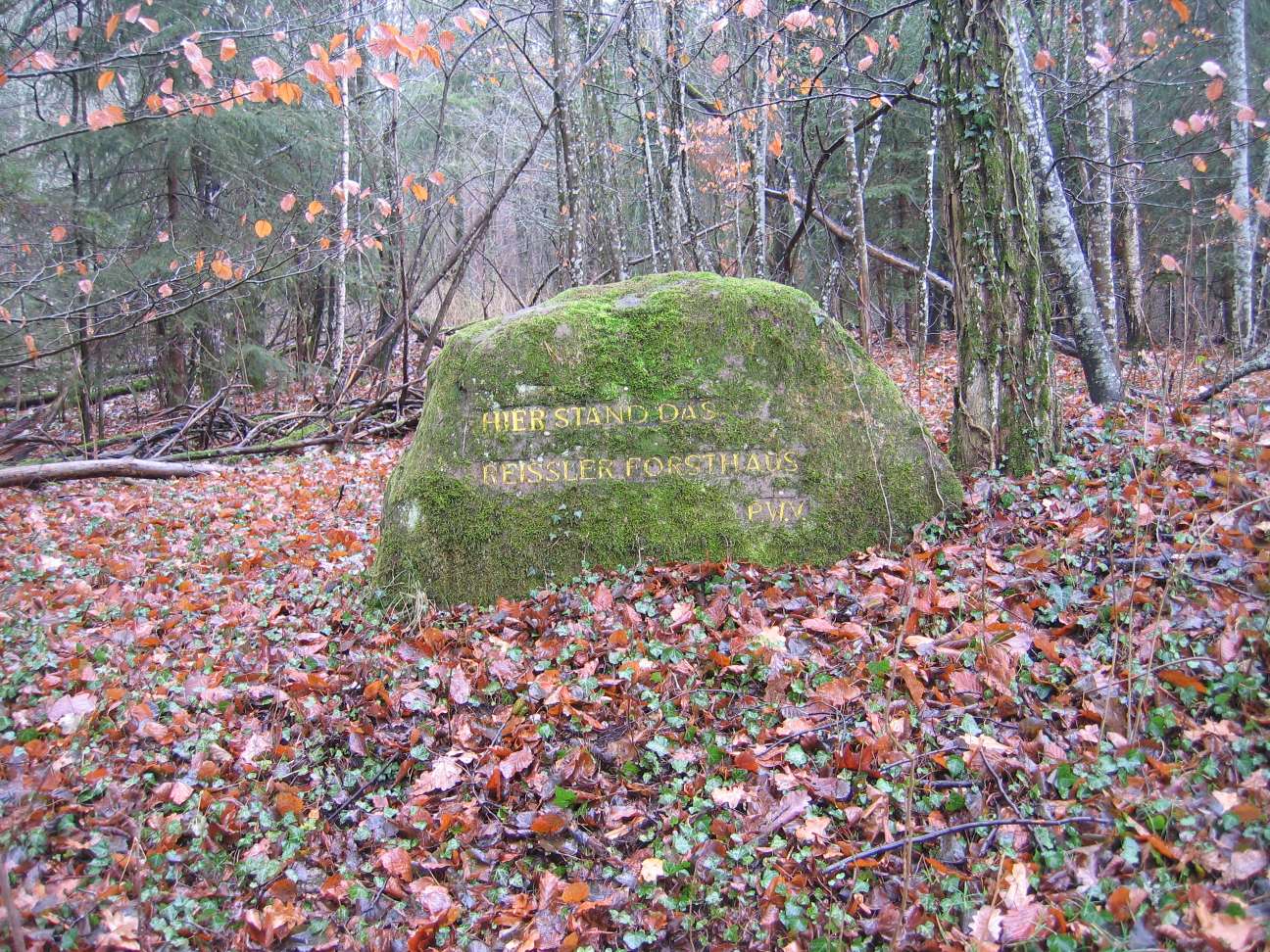
Ritterstein 197 "Reissler-Forsthaus"
DE
- Location
- DE
- Category
- iconic bucket list
- Coordinates
- 49.086949, 7.6585588
- Best time
- Morning or early afternoon
- Weather tip
- Check the local forecast before visiting.
Overview
Ritterstein 197, known as the 'Reissler-Forsthaus,' stands as a historical marker located north of the village of Ludwigswinkel, situated conveniently near the parking area at the Schöntalweiher. These stone markers, or 'Rittersteine,' are characteristic of the Palatinate Forest, serving as historical signposts that commemorate significant sites, viewpoints, or former structures. The Reissler-Forsthaus site itself marks the location of a former forester's lodge that once stood in this serene woodland setting. Tragically, the original structure was destroyed during the Second World War and was subsequently cleared, leaving the stone monument as a poignant reminder of the building that once occupied this space. Today, the marker serves as a point of interest for hikers and history enthusiasts exploring the Pfälzerwald. For those seeking places to visit in the region, this site offers a quiet moment of reflection on the local history of the Palatinate. It is an ideal stop for those looking for trip ideas that combine natural beauty with historical inquiry, allowing visitors to connect with the landscape's past while enjoying the surrounding trails. The marker is easily accessible from the Schöntalweiher parking lot, making it an uncomplicated addition to any forest excursion in this part of Germany.
General information
Ritterstein 197, known as the 'Reissler-Forsthaus,' stands as a historical marker located north of the village of Ludwigswinkel, situated conveniently near the parking area at the Schöntalweiher. These stone markers, or 'Rittersteine,' are characteristic of the Palatinate Forest, serving as historical signposts that commemorate significant sites, viewpoints, or former structures. The Reissler-Forsthaus site itself marks the location of a former forester's lodge that once stood in this serene woodland setting. Tragically, the original structure was destroyed during the Second World War and was subsequently cleared, leaving the stone monument as a poignant reminder of the building that once occupied this space. Today, the marker serves as a point of interest for hikers and history enthusiasts exploring the Pfälzerwald. For those seeking places to visit in the region, this site offers a quiet moment of reflection on the local history of the Palatinate. It is an ideal stop for those looking for trip ideas that combine natural beauty with historical inquiry, allowing visitors to connect with the landscape's past while enjoying the surrounding trails. The marker is easily accessible from the Schöntalweiher parking lot, making it an uncomplicated addition to any forest excursion in this part of Germany.
Did you know
- Rittersteine are sandstone blocks inscribed by the Pfälzerwald-Verein to mark historical points of interest.
- The 'Reissler-Forsthaus' was a functional forester's lodge before its destruction in the mid-20th century.
- The marker is located in the heart of the Biosphere Reserve Palatinate Forest-North Vosges.
History
The history of Ritterstein 197 is tied to the legacy of the Palatinate Forest's administrative buildings. The Reissler-Forsthaus was once a functional forestry house serving the local woodland management. During the hostilities of the Second World War, the structure suffered irreparable damage. Following the conflict, the remaining ruins were cleared, and the site was largely reclaimed by the forest. The installation of the Ritterstein serves as a permanent historical record, ensuring that the location of the former lodge is not lost to time, preserving the memory of the site for future generations of hikers and local researchers.
Cultural significance
The Rittersteine are culturally significant as a collective monument project initiated by the Pfälzerwald-Verein (Palatinate Forest Association). They represent a regional commitment to documenting local heritage, ranging from geological features to vanished architectural sites like the Reissler-Forsthaus. For the local community, these stones act as anchors of identity, grounding the modern recreational use of the forest in a deep, layered history. They transform a simple hike through the woods into an educational journey, encouraging visitors to interact with the landscape not just as a natural resource, but as a space shaped by centuries of human activity and historical change.
Geography and landscape
The site is situated north of Ludwigswinkel in the Pfälzerwald, one of the largest contiguous forest areas in Germany. The landscape is characterized by rolling hills, dense mixed woodlands, and the presence of the Schöntalweiher, a picturesque pond that serves as a focal point for the local area. The terrain here is typical of the Palatinate Forest, featuring sandstone formations and lush, green valleys. The proximity to the parking lot at the Schöntalweiher makes this a low-difficulty, accessible location, providing a tranquil woodland environment that is highly favored by hikers and nature lovers seeking a peaceful retreat.
More facts
- Imported from OSM batch
Visitor links
Nearby attractions
- Ritterstein 201 "Ruine Faunerhof" 2264 m
- Ritterstein 192 "Ruine Roesselsbrunner Hof" 2377 m
- Ritterstein 198 "Saarbach Ursprung" 2606 m
- Ritterstein 181 "Wasserscheide Rhein-Mosel" 4718 m
- Ritterstein 208 "Insel Suhl" 6910 m
- Ritterstein 210 "Ruine Storrwoogerhof" 7364 m
- Ritterstein 306 "Ruine Langkehler Sägemühle 1769–1894" 8311 m