Ritterstein 18 "Hühnerfels"
DE
- Location
- DE
- Category
- iconic bucket list
- Coordinates
- 49.0838033, 7.9074184
- Best time
- Morning or early afternoon
- Weather tip
- Check the local forecast before visiting.
Overview
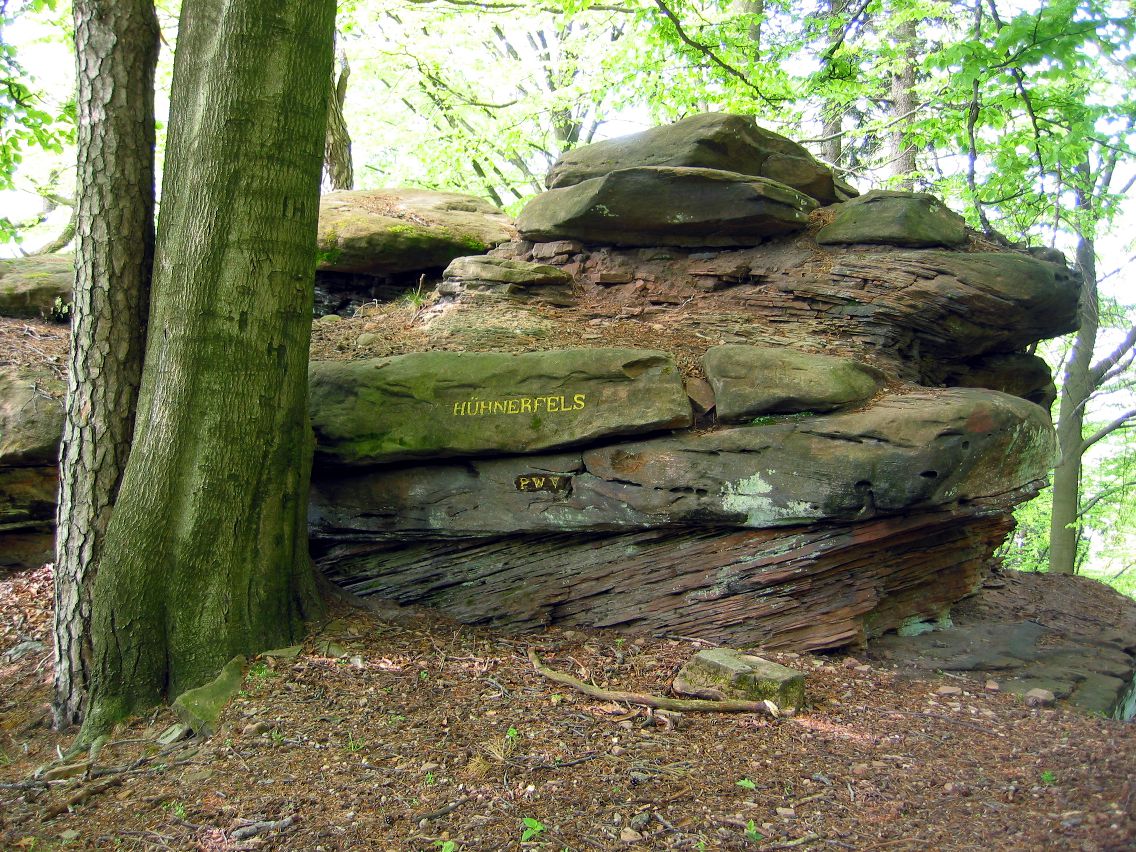
Ritterstein 18, known as the 'Hühnerfels,' is a fascinating historical marker located on the western slope of the Hohe Derst mountain in Germany. These 'Rittersteine' (Knight Stones) are a series of sandstone markers placed throughout the Palatinate Forest to commemorate historical, geographical, or cultural points of interest. The Hühnerfels is particularly notable for its inscription, which was carved directly into the natural, protruding rock face rather than onto a separate slab. Historically, this site is believed to have served as a lekking ground or mating display area for capercaillies—large forest grouse known in German as 'Auerhähne.' For hikers and history enthusiasts, exploring these unique markers offers a deeper connection to the region's heritage and natural history. Visitors looking for authentic trip ideas in the Pfälzerwald will find that the Hühnerfels provides a quiet, reflective stop amidst the dense forest canopy. Whether you are an avid historian or a nature lover, the site serves as a testament to the long-standing tradition of marking the landscape with human narratives. As you plan your visit, consider that the best time to view the rock is during the morning or early afternoon when natural light best illuminates the carved inscription. This site is an excellent example of the hidden gems found while trekking through the Palatinate, representing the intersection of regional folklore and forest ecology.
General information
Ritterstein 18, known as the 'Hühnerfels,' is a fascinating historical marker located on the western slope of the Hohe Derst mountain in Germany. These 'Rittersteine' (Knight Stones) are a series of sandstone markers placed throughout the Palatinate Forest to commemorate historical, geographical, or cultural points of interest. The Hühnerfels is particularly notable for its inscription, which was carved directly into the natural, protruding rock face rather than onto a separate slab. Historically, this site is believed to have served as a lekking ground or mating display area for capercaillies—large forest grouse known in German as 'Auerhähne.' For hikers and history enthusiasts, exploring these unique markers offers a deeper connection to the region's heritage and natural history. Visitors looking for authentic trip ideas in the Pfälzerwald will find that the Hühnerfels provides a quiet, reflective stop amidst the dense forest canopy. Whether you are an avid historian or a nature lover, the site serves as a testament to the long-standing tradition of marking the landscape with human narratives. As you plan your visit, consider that the best time to view the rock is during the morning or early afternoon when natural light best illuminates the carved inscription. This site is an excellent example of the hidden gems found while trekking through the Palatinate, representing the intersection of regional folklore and forest ecology.
Did you know
- The term 'Hühnerfels' refers to the historical presence of capercaillies, or 'Auerhähne,' at this specific site.
- Ritterstein 18 is part of a larger collection of over 300 sandstone markers distributed throughout the Palatinate Forest.
- Unlike many other Rittersteine, the inscription for number 18 was carved directly into the native bedrock.
History
The Rittersteine were established primarily by the Pfälzerwald-Verein starting in the early 20th century. The goal of these markers was to document historical events, local legends, and geographical features of the Palatinate region for future generations. Ritterstein 18, specifically, serves as a record of the former ecological significance of the Hohe Derst western slope as a habitat for the capercaillie. By preserving these names in stone, the project ensured that even as the forest changed, the memory of its past inhabitants remained etched into the landscape.
Cultural significance
The Hühnerfels represents the regional cultural commitment to preserving local history within the Palatinate Forest. The Pfälzerwald-Verein’s initiative to mark sites like this reflects a 19th and early 20th-century German tradition of romanticizing the forest and documenting its nuances. By labeling the site with a 'Ritterstein,' the community elevated a simple rocky outcrop to a point of historical interest, encouraging hikers to engage with the landscape as a narrative space rather than just a physical one.
Geography and landscape
The Hühnerfels is situated on the western flank of the Hohe Derst, a prominent elevation within the Palatinate Forest. The terrain is characterized by dense, mixed deciduous and coniferous woodland typical of the region's low mountain range. The rock itself is a natural sandstone formation, which is geologically representative of the Buntsandstein (colored sandstone) layers that form the bedrock of the Palatinate. The site is surrounded by rugged forest trails that offer a quintessential experience of the German Mittelgebirge landscape.
More facts
- Imported from OSM batch
Visitor links
Nearby attractions
- Ritterstein 27 "Signal" 545 m
- Ritterstein 13 "Hirschtränke" 946 m
- Ritterstein 15 "R. Schlosshütte" 1052 m
- Ritterstein 21 "Drei Eichen" 1400 m
- Ritterstein 14 "Drei Buchen" 1410 m
- Ritterstein 23 "Am Bild" 1499 m
- Ritterstein 11 "R. Buchbacherhof" 1762 m
- Ritterstein 8 "Mundathütte" 1946 m