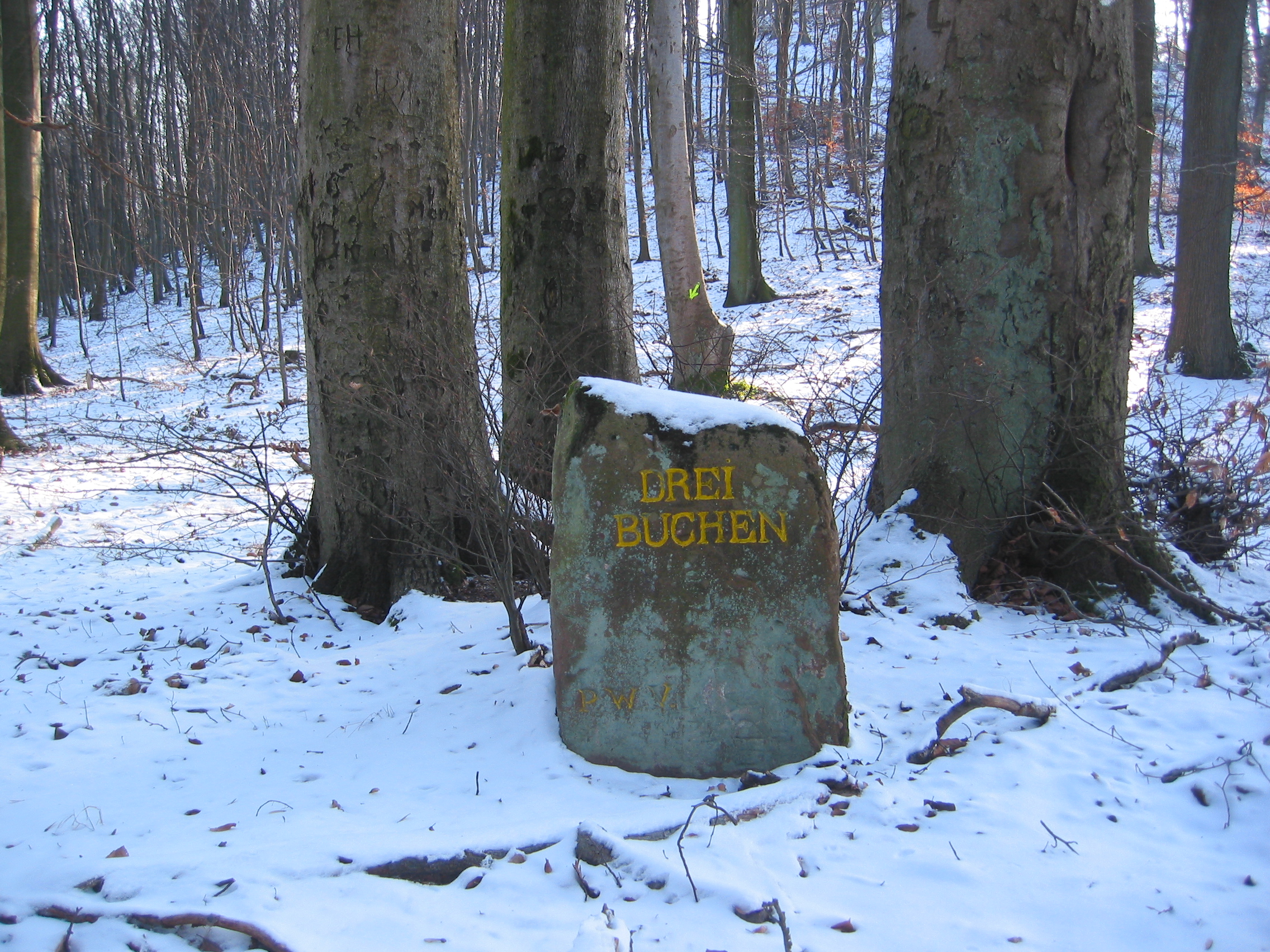
Ritterstein 14 "Drei Buchen"
DE
- Location
- DE
- Category
- iconic bucket list
- Coordinates
- 49.0757748, 7.9223623
- Best time
- Morning or early afternoon
- Weather tip
- Check the local forecast before visiting.
Overview
Ritterstein 14, known as 'Drei Buchen' (Three Beeches), is a significant historical marker located in the Palatinate Forest of Germany. Situated in the saddle between the Schloßberg and Querenberg mountains, this site marks the transition point to the Mundatwald, a historically protected forest region. The Ritterstein serves as a durable stone monument, part of a unique series of markers placed by the Pfälzerwald-Verein to commemorate specific historical, geographical, or natural landmarks throughout the region. Visitors seeking meaningful trip ideas often include these markers in their hiking itineraries, as they provide a tangible connection to the area's heritage. The site is characterized by the presence of three majestic beech trees, which have long defined the location and provided a natural landmark for travelers navigating the dense forest trails. For those planning what to do in the area, the site offers a quiet, contemplative space that rewards hikers with a glimpse into the traditional way of documenting the landscape. Whether you are an avid hiker or a history enthusiast, the Drei Buchen Ritterstein offers a quintessential experience of the Palatinate Forest’s rugged charm, standing as a silent witness to the centuries of forestry and travel that have shaped this terrain.
General information
Ritterstein 14, known as 'Drei Buchen' (Three Beeches), is a significant historical marker located in the Palatinate Forest of Germany. Situated in the saddle between the Schloßberg and Querenberg mountains, this site marks the transition point to the Mundatwald, a historically protected forest region. The Ritterstein serves as a durable stone marker, part of a unique series placed by the Pfälzerwald-Verein to commemorate specific historical, geographical, or natural landmarks throughout the region. Visitors seeking meaningful trip ideas often include these markers in their hiking itineraries, as they provide a tangible connection to the area's heritage. The site is characterized by the presence of three majestic beech trees, which have long defined the location and provided a natural landmark for travelers navigating the dense forest trails. For those planning what to do in the area, the site offers a quiet, contemplative space that rewards hikers with a glimpse into the traditional way of documenting the landscape. Whether you are an avid hiker or a history enthusiast, the Drei Buchen Ritterstein offers a quintessential experience of the Palatinate Forest’s rugged charm, standing as a silent witness to the centuries of forestry and travel that have shaped this terrain.
Did you know
- Rittersteine are sandstone blocks engraved with historical information, maintained by the Pfälzerwald-Verein.
- The 'Drei Buchen' marker is number 14 in the official list of over 300 such stones in the Palatinate Forest.
- The site sits precisely on the border of the Mundatwald, a forest area with a complex history involving military and forestry usage.
History
The history of Ritterstein 14 is tied to the efforts of the Pfälzerwald-Verein, an organization founded in 1902 to promote tourism and the preservation of the Palatinate Forest. These stone markers were systematically placed to preserve local knowledge and landmark names that might otherwise be forgotten. 'Drei Buchen' refers to the historical significance of the three beech trees at this specific mountain saddle, which served as a navigational waypoint for foresters and travelers long before the modern trail markers were established. The stone itself functions as a permanent record of this natural feature.
Cultural significance
The Ritterstein markers are a cultural institution in the Palatinate region, representing a deep-rooted tradition of 'Heimatpflege' or the cultivation of local identity. They transform the forest into a living archive, where every stone tells a story of the landscape. For local hikers, finding a Ritterstein is a point of pride and a meditative exercise in local geography. The 'Drei Buchen' specifically highlights the human tendency to anthropomorphize and name natural features, turning a simple stand of trees into a recognized geographic landmark.
Geography and landscape
The site is located in a high-elevation saddle between the Schloßberg and Querenberg peaks. The terrain is typical of the Palatinate Forest, characterized by Triassic sandstone formations and dense mixed-deciduous forests. The location serves as a topographical gateway to the Mundatwald, a large, contiguous forest area in the southern part of the Palatinate. The landscape is rugged and undulating, with the three beech trees providing a distinct vertical element against the horizon of the mountain saddle, making it a natural focal point for the surrounding trail network.
More facts
- Imported from OSM batch
Visitor links
Nearby attractions
- Ritterstein 15 "R. Schlosshütte" 434 m
- Ritterstein 11 "R. Buchbacherhof" 928 m
- Ritterstein 13 "Hirschtränke" 1234 m
- Ritterstein 27 "Signal" 1315 m
- Ritterstein 21 "Drei Eichen" 1361 m
- Ritterstein 18 "Hühnerfels" 1410 m
- Ritterstein 7 "Wegscheid" 1646 m
- Ritterstein 23 "Am Bild" 1654 m