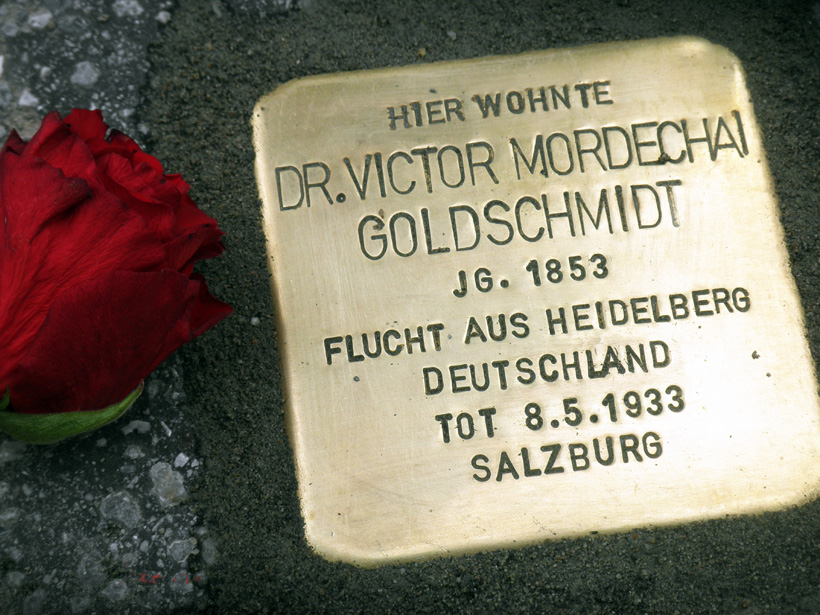
Victor Mordechai Goldschmidt
Salzburg, IL
- Location
- Salzburg, IL
- Category
- iconic bucket list
- Coordinates
- 47.8056669, 13.0477718
- Best time
- Morning or early afternoon
- Weather tip
- Check the local forecast before visiting.
Overview
The Victor Mordechai Goldschmidt Stolperstein is a significant memorial marker located in Salzburg, Austria. Part of the broader Stolpersteine project—the world's largest decentralized memorial—this brass-plated cobblestone is embedded in the pavement in front of the building where Victor Mordechai Goldschmidt once lived. These markers serve as a poignant reminder of the individuals who were persecuted, deported, or murdered by the National Socialist regime between 1933 and 1945. For visitors exploring the city, this site offers a moment of quiet reflection amidst the urban landscape. It is one of many such memorials throughout Europe, designed to restore the names and personal histories of victims to the streets they once called home. When planning your visit to Salzburg, these markers are essential stops for those interested in historical remembrance and 20th-century history. While looking for places to visit in the historic center, many travelers find that these small, bronze-inlaid stones provide a profound connection to the past, grounding the tourist experience in the reality of the city's complex history. It is a somber yet vital addition to any itinerary, offering a unique perspective on the human cost of the Holocaust. Visitors are encouraged to approach these sites with respect as they walk through the city streets, serving as a reminder that history is never far beneath our feet.
General information
The Victor Mordechai Goldschmidt Stolperstein is a significant memorial marker located in Salzburg, Austria. Part of the broader Stolpersteine project—the world's largest decentralized memorial—this brass-plated cobblestone is embedded in the pavement in front of the building where Victor Mordechai Goldschmidt once lived. These markers serve as a poignant reminder of the individuals who were persecuted, deported, or murdered by the National Socialist regime between 1933 and 1945. For visitors exploring the city, this site offers a moment of quiet reflection amidst the urban landscape. It is one of many such memorials throughout Europe, designed to restore the names and personal histories of victims to the streets they once called home. When planning your visit to Salzburg, these markers are essential stops for those interested in historical remembrance and 20th-century history. While looking for places to visit in the historic center, many travelers find that these small, bronze-inlaid stones provide a profound connection to the past, grounding the tourist experience in the reality of the city's complex history. It is a somber yet vital addition to any itinerary, offering a unique perspective on the human cost of the Holocaust. Visitors are encouraged to approach these sites with respect as they walk through the city streets, serving as a reminder that history is never far beneath our feet.
Did you know
- The term 'Stolperstein' literally translates to 'stumbling stone', intended to make passersby 'stumble' over the name with their minds rather than their feet.
- The Stolpersteine project was initiated by German artist Gunter Demnig in 1992.
- Each stone is hand-crafted and individually placed to commemorate a specific victim of Nazi persecution at their last known place of residence.
History
Victor Mordechai Goldschmidt was a victim of the Nazi regime during the period of the Holocaust. The Stolperstein dedicated to his memory was installed to document his life and his tragic fate, ensuring that his name remains a part of Salzburg's historical record. The memorialization process involves extensive archival research to verify the dates and circumstances of the victim's life and death. By placing these stones, the project aims to reverse the anonymity imposed by the perpetrators, who sought to erase the identities of their victims. This specific stone stands as a factual record of a life cut short, providing a tangible link to the history of Salzburg's Jewish community during the 1930s and 1940s.
Cultural significance
The Stolperstein represents a grassroots approach to cultural memory. Unlike large, centralized monuments, these stones are integrated into the daily life of the city, forcing a confrontation with history in the midst of mundane activities. They reflect a commitment by the local community and international organizations to keep the memory of the Holocaust alive in the very spaces where it occurred. The project has become a global symbol of remembrance, encouraging empathy and education. By maintaining these markers, Salzburg acknowledges its past, fostering a culture of accountability and reflection that resonates with both residents and international visitors who seek to understand the impact of the Holocaust on European society.
Geography and landscape
The Victor Mordechai Goldschmidt Stolperstein is located in the urban fabric of Salzburg, Austria. It is set directly into the sidewalk, flush with the surrounding cobblestones or pavement, typical of the city's historic architectural style. The location is situated in a residential or commercial area where the victim once resided. The surroundings are characterized by the classic, dense urban layout of Salzburg, featuring historic buildings and busy pedestrian walkways. Because the memorial is part of the streetscape, it is exposed to the elements and the daily flow of city life, emphasizing the integration of historical memory into the contemporary environment of the city.
More facts
- Imported from OSM Overpass
Visitor links
Nearby attractions
- Hermann Kohn Salzburg - 27 m
- Bertha Kohn Salzburg - 28 m
- Konrad Hertzka Salzburg - 61 m
- Juliana Leitner Salzburg - 86 m
- Otto Horst Salzburg - 103 m
- Johann Graber Salzburg - 104 m
- Rudolf Raspotnig Salzburg - 127 m
- Herbert Schmalzbach-Pirak Salzburg - 152 m