The Pillbox
Tel-Aviv, IL

- Location
- Tel-Aviv, IL
- Category
- heritage historic sites
- Coordinates
- 32.0334219, 34.7688482
- Best time
- Morning or early afternoon
- Weather tip
- Check the local forecast before visiting.
Overview
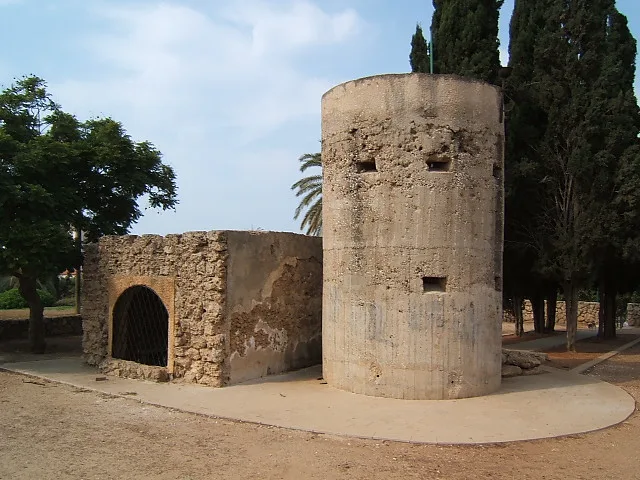
The Pillbox in Tel Aviv stands as a tangible remnant of the British Mandate period in Palestine. These small, reinforced concrete defensive structures, officially known as 'blockhouses,' were strategically erected by the British authorities during the late 1930s, particularly in response to the 1936–1939 Arab revolt. Designed to provide a fortified position for a small number of troops, these pillboxes functioned as checkpoints to control movement and secure critical junctions, borders, and urban perimeters. Today, the surviving pillboxes serve as historical markers, offering visitors a unique perspective on the military architecture and security policies of the pre-state era. For those interested in historical exploration, these sites are essential stops when considering places to visit to understand the complex layers of Tel Aviv's urban development. Visitors will find that these structures, often weathered by time and integrated into the modern city landscape, offer a stark contrast to the surrounding contemporary architecture. While they are no longer functional, their presence allows for a reflective look at the geopolitical tensions that defined the region during the mid-20th century. When planning your trip, including these sites provides valuable context for understanding the city's evolution. Exploring these remnants is a significant activity for anyone seeking unique trip ideas that bridge the gap between colonial history and the vibrant, modern metropolis that Tel Aviv has become.
General information
The Pillbox in Tel Aviv stands as a tangible remnant of the British Mandate period in Palestine. These small, reinforced concrete defensive structures, officially known as 'blockhouses,' were strategically erected by the British authorities during the late 1930s, particularly in response to the 1936–1939 Arab revolt. Designed to provide a fortified position for a small number of troops, these pillboxes functioned as checkpoints to control movement and secure critical junctions, borders, and urban perimeters. Today, the surviving pillboxes serve as historical markers, offering visitors a unique perspective on the military architecture and security policies of the pre-state era. For those interested in historical exploration, these sites are essential stops when considering places to visit to understand the complex layers of Tel Aviv's urban development. Visitors will find that these structures, often weathered by time and integrated into the modern city landscape, offer a stark contrast to the surrounding contemporary architecture. While they are no longer functional, their presence allows for a reflective look at the geopolitical tensions that defined the region during the mid-20th century. When planning your trip, including these sites provides valuable context for understanding the city's evolution. Exploring these remnants is a significant activity for anyone seeking unique trip ideas that bridge the gap between colonial history and the vibrant, modern metropolis that Tel Aviv has become.
Did you know
- The term 'pillbox' refers to the structure's shape, which resembles the small, cylindrical boxes used for dispensing pills in the early 20th century.
- Most pillboxes were built with multiple firing slits to allow soldiers to defend the position from all angles.
- These structures were often positioned at key intersections to monitor and control the flow of traffic during the British Mandate.
History
The Pillboxes in Tel Aviv were constructed primarily between 1936 and 1939. This period, known as the Arab Revolt, saw significant unrest in Palestine, leading the British Mandate administration to implement extensive security measures. The pillboxes were part of a broader network of defensive fortifications designed to protect British personnel, police stations, and key transport routes from insurgent attacks. By placing these structures at strategic intervals, the British military could maintain a constant, albeit limited, presence across urban and rural landscapes. Following the end of the British Mandate in 1948, many of these structures were either demolished to make way for urban expansion or repurposed by local authorities. The few that remain today are preserved as historical artifacts, documenting a volatile period of transition in the history of the region.
Cultural significance
The Pillbox serves as a stark historical monument to the British presence in pre-state Israel. Culturally, these structures represent a period of military oversight and colonial architecture that contrasts sharply with the Bauhaus and modern styles that dominate much of Tel Aviv. They act as physical reminders of the security concerns that shaped the daily lives of residents during the 1930s and 1940s. While they are not traditional heritage sites in the sense of museums or monuments, their preservation allows historians and the public to examine the impact of foreign rule on the local landscape. They are a point of historical curiosity, prompting discussions about the legacy of the Mandate era and the rapid transformation of Tel Aviv from a small neighborhood into a major international city.
Geography and landscape
The Pillbox structures are typically found in urban environments, often situated near road junctions, bridges, or the perimeters of historic city boundaries. In Tel Aviv, they are integrated into the modern streetscape, often appearing as isolated, concrete remnants amidst residential buildings, busy intersections, or commercial areas. The terrain is largely flat, consistent with the coastal plain of Israel upon which Tel Aviv is built. Over the decades, the rapid urban development of the city has effectively 'swallowed' many of these structures, leaving them as silent observers of the modern traffic and daily activity that now surrounds them. Their presence in the landscape is characterized by their utilitarian design—thick concrete walls and narrow slits—which stands out against the lighter, more aesthetic architectural styles prevalent in the city.
More facts
- Imported from OSM batch
Visitor links
Nearby attractions
- Gaon Stadium Tel-Aviv - 1345 m
- Nature gardens Tel-Aviv - 1782 m
- Alon Segev Gallery Tel Aviv - 1875 m
- Holon Sculpture Garden Holon - 1935 m
- Israeli Cartoon Museum Holon - 1966 m
- Galeryah Rozenfeld Tel Aviv - 2094 m
- Ajami Water Tower Tel-Aviv - 2112 m
- Beit Benyamini Tel Aviv - 2122 m