Schimmel, a ló
HU
- Location
- HU
- Category
- heritage historic sites
- Coordinates
- 47.595185, 19.347959
- Best time
- Morning or early afternoon
- Weather tip
- Check the local forecast before visiting.
Overview
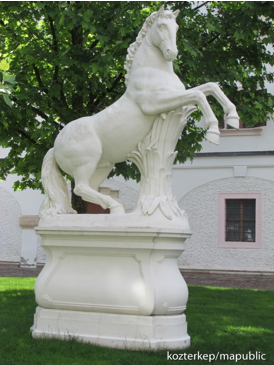
The Schimmel statue, often referred to as 'Schimmel, a ló' (Schimmel, the horse), serves as a poignant monument to the 18th-century noble history of Hungary. This sculpture depicts the favorite horse of Antal Grassalkovich I, a prominent aristocrat and influential figure during the reign of Maria Theresa. The original statue was a notable piece of 18th-century art, but it tragically disappeared in the chaotic aftermath of the Second World War. For decades, the pedestal remained a silent witness to history until efforts were made to restore the monument. The current sculpture is a reconstruction, meticulously crafted based on a single recovered fragment of the original and historical photographs. Visitors interested in historical monuments will find this a fascinating stop when exploring local attractions, as it offers a glimpse into the personal lives of the Hungarian nobility. The statue is a testament to the dedication of local historians and conservators who work to preserve the tangible heritage of the region. As you consider various trip ideas, this site provides a unique connection to the Grassalkovich era, standing as a symbol of resilience and historical continuity. It is an excellent example of how communities reclaim their past, making it a meaningful addition to any itinerary focused on the cultural evolution of Hungarian statuary and aristocratic legacy.
General information
The Schimmel statue, often referred to as 'Schimmel, a ló' (Schimmel, the horse), serves as a poignant monument to the 18th-century noble history of Hungary. This sculpture depicts the favorite horse of Antal Grassalkovich I, a prominent aristocrat and influential figure during the reign of Maria Theresa. The original statue was a notable piece of 18th-century art, but it tragically disappeared in the chaotic aftermath of the Second World War. For decades, the pedestal remained a silent witness to history until efforts were made to restore the monument. The current sculpture is a reconstruction, meticulously crafted based on a single recovered fragment of the original and historical photographs. Visitors interested in historical monuments will find this a fascinating stop when exploring local attractions, as it offers a glimpse into the personal lives of the Hungarian nobility. The statue is a testament to the dedication of local historians and conservators who work to preserve the tangible heritage of the region. As you consider various trip ideas, this site provides a unique connection to the Grassalkovich era, standing as a symbol of resilience and historical continuity. It is an excellent example of how communities reclaim their past, making it a meaningful addition to any itinerary focused on the cultural evolution of Hungarian statuary and aristocratic legacy.
Did you know
- The original 18th-century statue was lost for decades following the events of World War II.
- The reconstruction was possible only due to the survival of a single physical fragment and archival photography.
- The horse belonged to Antal Grassalkovich I, a major political figure in the 18th-century Habsburg Empire.
History
Commissioned in the 18th century, the original statue honored the favored mount of Antal Grassalkovich I, a member of the high nobility who held significant influence in the Hungarian Kingdom. Following the destruction and displacement of artworks during the Second World War, the statue vanished from public view. The current monument is a modern reconstruction that bridges the gap between the 18th-century original and contemporary historical preservation efforts, utilizing surviving visual records and the lone remaining physical artifact to recreate the likeness of the horse.
Cultural significance
The statue represents the historical importance of the Grassalkovich family, whose influence shaped much of the architectural and cultural landscape of the region during the 18th century. By recreating this monument, the local community emphasizes the value of preserving aristocratic heritage and the personal narratives that humanize historical figures. It stands as a symbol of the effort to reconstruct a narrative interrupted by the devastation of war, serving as a cultural touchstone for those interested in Hungarian history and the evolution of public commemorative art.
Geography and landscape
The statue is situated within the historic grounds associated with the legacy of the Grassalkovich family. The setting typically features well-maintained landscaping consistent with the formal gardens or estate environments where such noble monuments were traditionally displayed. The surrounding area reflects the urban or semi-urban context of the historic site, providing a quiet, contemplative space that allows the sculpture to serve as a focal point for visitors. The terrain is generally flat, typical of the regional geography where the estate is located.
More facts
- Imported from OpenStreetMap batch
Visitor links
Nearby attractions
- Horváth–Kispál-kereszt 180 m
- Maria Theresa 262 m
- István Horthy 494 m
- Petőfi Sándor 645 m
- Kismuki egykori váltója 2891 m
- Kapucinus kereszt 3758 m
- Szent László kilátó és kápolna 6593 m
- Aulich Lajos 7462 m