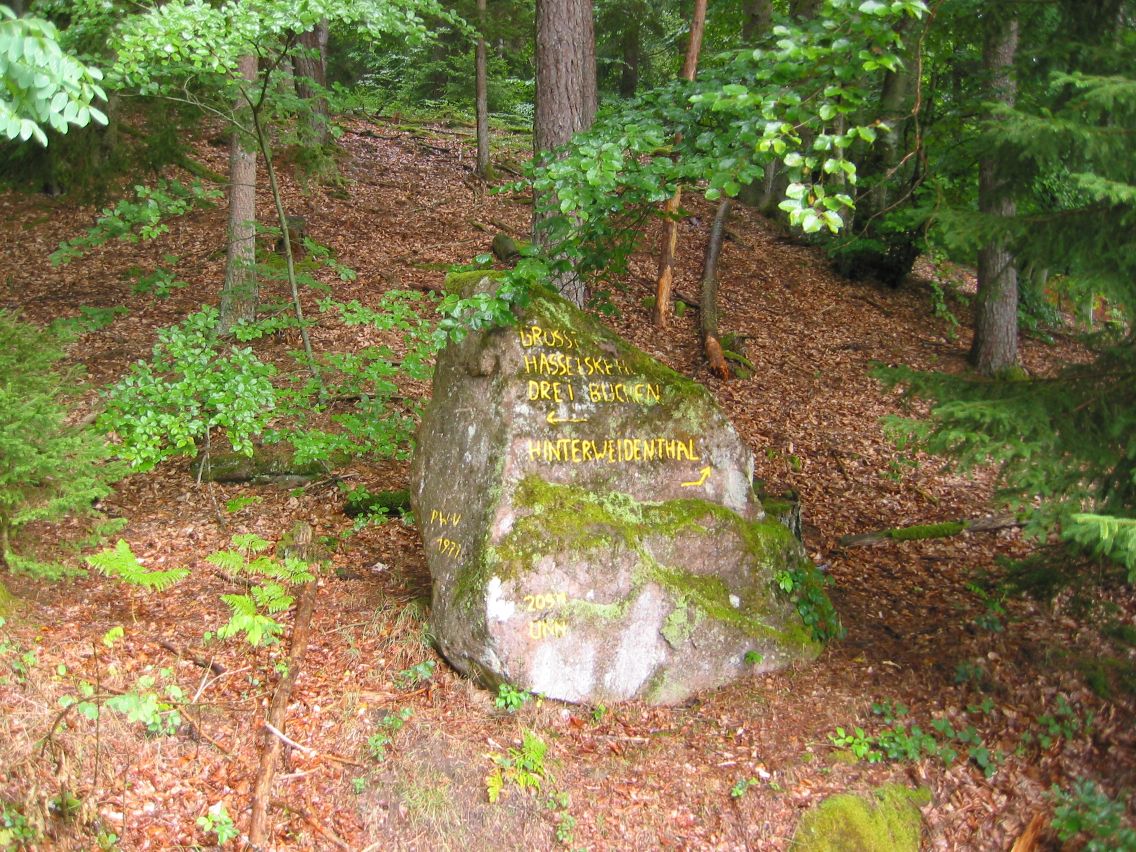
Ritterstein 215 "Grosse Hasselskehl"
DE
- Location
- DE
- Category
- iconic bucket list
- Coordinates
- 49.1703865, 7.7471637
- Best time
- Morning or early afternoon
- Weather tip
- Check the local forecast before visiting.
Overview
Ritterstein 215, known as 'Grosse Hasselskehl,' is a historic sandstone marker located in the scenic Palatinate Forest, northwest of the town of Dahn, Germany. These distinct markers, known as 'Rittersteine' (Knight's Stones), are an integral part of the region's hiking heritage, serving as historical signposts that document local topography, folklore, and forestry history. Positioned strategically between the Eselsbühl, Lehmberg, and the Großer Hellenberg, this specific site serves as a vital orientation point for outdoor enthusiasts navigating the complex trail networks of the Dahner Felsenland. Visitors traveling to this area will find that the Ritterstein offers a unique glimpse into the 19th and 20th-century efforts to map and label the dense forest landscape for recreational use. As you explore the region, you will discover that these stones provide essential context for understanding the cultural history of the Palatinate. For those seeking trip ideas in the Pfälzerwald, Ritterstein 215 serves as a perfect waypoint during a hike through the rugged sandstone formations. It is highly recommended to plan your visit during the morning or early afternoon to take advantage of the natural light filtering through the canopy. As with any trek in this region, checking the local weather forecast is essential, as the terrain requires stable conditions for safe navigation. Whether you are a history enthusiast or a dedicated hiker, this site remains one of the most interesting local attractions for those exploring the hidden corners of the Dahn region.
General information
Ritterstein 215, known as 'Grosse Hasselskehl,' is a historic sandstone marker located in the scenic Palatinate Forest, northwest of the town of Dahn, Germany. These distinct markers, known as 'Rittersteine' (Knight's Stones), are an integral part of the region's hiking heritage, serving as historical signposts that document local topography, folklore, and forestry history. Positioned strategically between the Eselsbühl, Lehmberg, and the Großer Hellenberg, this specific site serves as a vital orientation point for outdoor enthusiasts navigating the complex trail networks of the Dahner Felsenland. Visitors traveling to this area will find that the Ritterstein offers a unique glimpse into the 19th and 20th-century efforts to map and label the dense forest landscape for recreational use. As you explore the region, you will discover that these stones provide essential context for understanding the cultural history of the Palatinate. For those seeking trip ideas in the Pfälzerwald, Ritterstein 215 serves as a perfect waypoint during a hike through the rugged sandstone formations. It is highly recommended to plan your visit during the morning or early afternoon to take advantage of the natural light filtering through the canopy. As with any trek in this region, checking the local weather forecast is essential, as the terrain requires stable conditions for safe navigation. Whether you are a history enthusiast or a dedicated hiker, this site remains one of the most interesting local attractions for those exploring the hidden corners of the Dahn region.
Did you know
- The 'Rittersteine' are named after the Pfälzerwald-Verein, whose members were affectionately nicknamed 'Ritter' (knights) for their dedication to marking trails.
- Ritterstein 215 is one of hundreds of such stone markers scattered throughout the Palatinate Forest.
- These stones were traditionally carved from local Buntsandstein (variegated sandstone), which is characteristic of the region's geology.
History
The Rittersteine were established primarily during the late 19th and early 20th centuries by the Pfälzerwald-Verein. These markers were intended to provide hikers with permanent, weather-resistant orientation points in an era before modern cartography was widely available. Each stone is typically engraved with a number and a location name, often referencing historical events, geographical features, or local legends. Ritterstein 215, 'Grosse Hasselskehl,' represents a deliberate effort by local conservationists and hiking pioneers to formalize the network of paths in the Dahn area, ensuring that travelers could reliably identify their position within the vast, often disorienting landscape of the Palatinate Forest.
Cultural significance
Rittersteine are considered cultural monuments of the Palatinate region. They symbolize the birth of organized hiking and the democratization of the forest as a recreational space for the public. By marking places like Grosse Hasselskehl, the Pfälzerwald-Verein helped build a regional identity centered on the appreciation of the forest. These stones are not merely functional tools; they are historical documents that preserve the linguistic and geographical naming conventions of the past. Today, they are protected as heritage sites, reflecting the enduring value the local community places on its natural and cultural history.
Geography and landscape
The site is situated within the Dahner Felsenland, a sub-region of the Palatinate Forest characterized by dramatic red sandstone rock formations and dense deciduous and coniferous woodlands. Ritterstein 215 sits at a topographical junction between the Eselsbühl, Lehmberg, and Großer Hellenberg peaks. The terrain is undulating and largely forested, offering a classic mid-range mountain hiking experience. The soil composition is primarily sandy, typical of the Triassic Buntsandstein landscape, which influences the local flora and the rugged, weathered appearance of the sandstone markers themselves.
More facts
- Imported from OSM batch
Visitor links
Nearby attractions
- Ritterstein 211 "Wolfsdeller Hals" 1602 m
- Ritterstein 306 "Ruine Langkehler Sägemühle 1769–1894" 4332 m
- Ritterstein 208 "Insel Suhl" 4429 m
- Ritterstein 210 "Ruine Storrwoogerhof" 4744 m
- Ritterstein 230 "Wieslauter Ursprung" 6384 m
- Ritterstein 218 "Ruine Karolingisches Gehöft" 6773 m
- Ritterstein 40 "R. Granitzenhütte" 6780 m
- Ritterstein 223 "Starkenbrunnen" 7014 m