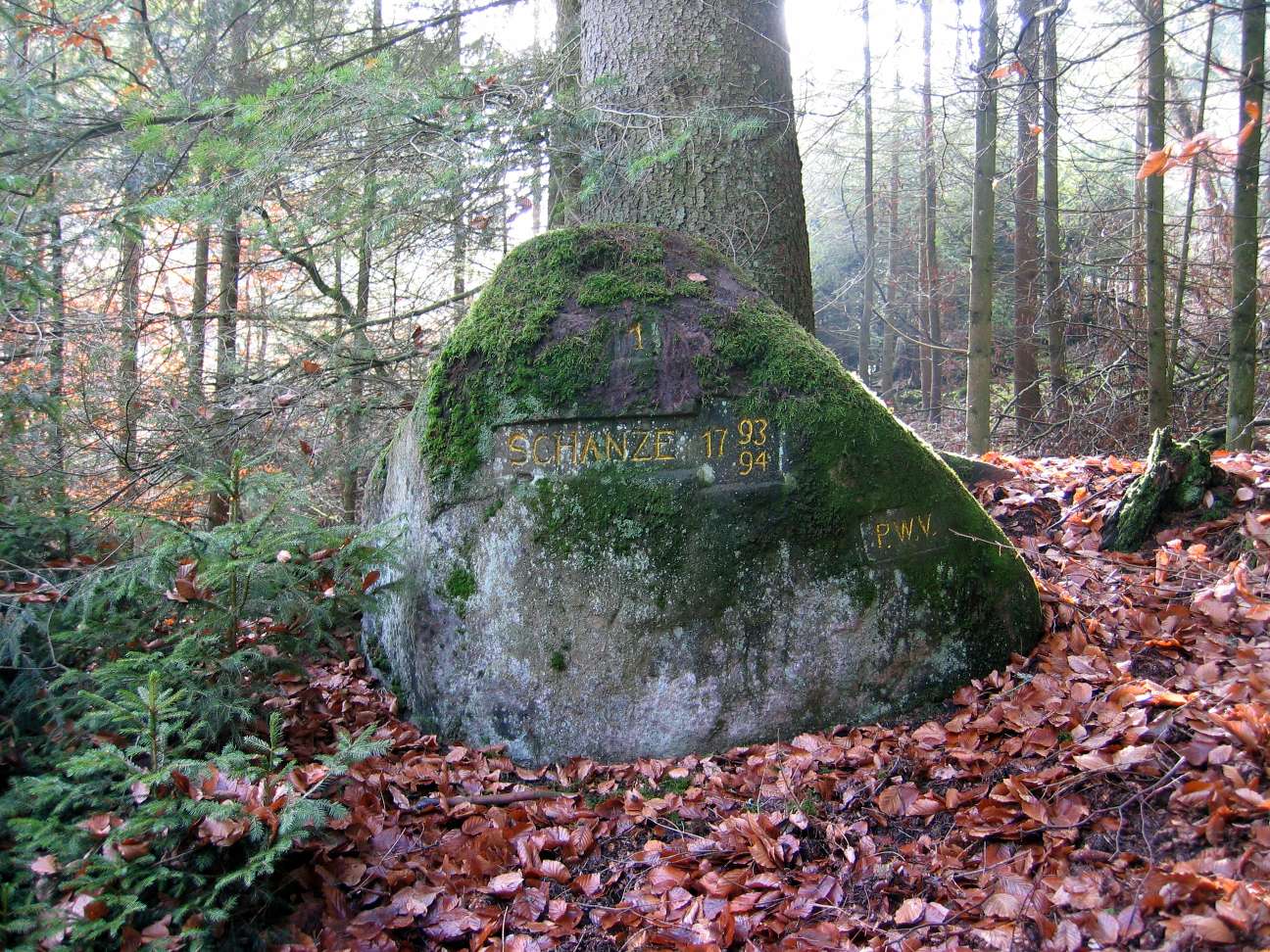
Ritterstein 170 "Schanze 1"
DE
- Location
- DE
- Category
- iconic bucket list
- Coordinates
- 49.4720355, 7.9514572
- Best time
- Morning or early afternoon
- Weather tip
- Check the local forecast before visiting.
Overview
Ritterstein 170, known as 'Schanze 1', is a significant historical marker located in the Palatinate Forest region of Germany. Situated west of the trail in Langenthal, between the Großes Kieneck and the Krummes Eck, this site serves as a tangible reminder of 18th-century military engineering. The marker commemorates a Prussian 'Schanze'—a fortified earthwork or redoubt—constructed during the turbulent years of the French Revolutionary Wars, specifically the War of the First Coalition (1793–1797). For those looking for unique places to visit, this site offers a quiet, reflective experience amidst the dense German woodlands. Visitors can expect a rugged, forested landscape that requires a bit of navigation to locate, making it a rewarding discovery for history enthusiasts and hikers alike. As you explore this area, you will find it is one of many fascinating local attractions that document the strategic defense lines established by Prussian forces during their conflict with revolutionary France. Whether you are planning your next trip ideas to the region or simply enjoy historical trekking, the Ritterstein 170 provides a stark, authentic connection to the past. The site is best accessed during the morning or early afternoon to ensure sufficient daylight for exploring the surrounding terrain. Please check the local weather forecast before visiting, as the forest paths can become challenging after rainfall.
General information
Ritterstein 170, known as 'Schanze 1', is a significant historical marker located in the Palatinate Forest region of Germany. Situated west of the trail in Langenthal, between the Großes Kieneck and the Krummes Eck, this site serves as a tangible reminder of 18th-century military engineering. The marker commemorates a Prussian 'Schanze'—a fortified earthwork or redoubt—constructed during the turbulent years of the French Revolutionary Wars, specifically the War of the First Coalition (1793–1797). For those looking for unique places to visit, this site offers a quiet, reflective experience amidst the dense German woodlands. Visitors can expect a rugged, forested landscape that requires a bit of navigation to locate, making it a rewarding discovery for history enthusiasts and hikers alike. As you explore this area, you will find it is one of many fascinating local attractions that document the strategic defense lines established by Prussian forces during their conflict with revolutionary France. Whether you are planning your next trip ideas to the region or simply enjoy historical trekking, the Ritterstein 170 provides a stark, authentic connection to the past. The site is best accessed during the morning or early afternoon to ensure sufficient daylight for exploring the surrounding terrain. Please check the local weather forecast before visiting, as the forest paths can become challenging after rainfall.
Did you know
- Rittersteine are sandstone markers found in the Palatinate Forest that commemorate historical events, locations, or geographical features.
- The term 'Schanze' refers to a field fortification, typically consisting of earthworks used for defensive purposes.
- This specific marker commemorates military activity from the War of the First Coalition, which lasted from 1792 to 1797.
History
Ritterstein 170 marks the site of a Prussian redoubt (Schanze) dating to the War of the First Coalition (1793–1797). During this period, the German states, including Prussia, were engaged in military conflicts against the newly formed French Republic. The 'Schanze 1' was part of a series of defensive positions established to secure the region against French incursions. These field fortifications were typically temporary structures made of soil and timber, intended to hold strategic mountain passes or valley access points. Today, the Ritterstein serves as a permanent, stone-carved record of these transient military efforts, allowing modern visitors to identify the exact location of these 18th-century defensive lines.
Cultural significance
The Ritterstein markers are a cultural institution in the Palatinate Forest. Initiated by the Pfälzerwald-Verein in the early 20th century, these sandstone blocks were placed to preserve local history and provide orientation for hikers. 'Schanze 1' represents the intersection of regional heritage and broader European military history. By marking the location of the Prussian defensive earthworks, the stone helps maintain the collective memory of the Revolutionary Wars' impact on the local population. It transforms the forest into an open-air archive, where the physical landscape is layered with historical narrative, fostering a deeper appreciation for the region's long-standing connection to European geopolitical shifts.
Geography and landscape
The site is located in the heart of the Palatinate Forest (Pfälzerwald), characterized by dense deciduous and coniferous woodland, deep valleys, and sandstone outcroppings. The terrain is rugged and undulating, typical of the low mountain ranges in this part of Germany. 'Schanze 1' is positioned in the Langenthal valley, nestled between the elevations known as Großes Kieneck and Krummes Eck. The landscape is dominated by narrow, winding forest paths that follow the natural contours of the valley. Being an outdoor location, the environment is subject to seasonal changes, with lush green foliage in the summer and potential mud or leaf-covered trails during the autumn and spring months.
More facts
- Imported from OSM batch
Visitor links
Nearby attractions
- Ritterstein “Gerbersdell” 989 m
- Ritterstein 176 "Schorlenberger Sohl" 1298 m
- Ritterstein 179 "F. Schorlenberg" 1379 m
- Ritterstein 283 "Langenthaler Hof" 1474 m
- Ritterstein 174 "Schanze 5" 1856 m
- Ritterstein 175 "Schanze 6" 2407 m
- Ritterstein 164 "Rattenfels" 2670 m
- Ritterstein 163 "Franzosenwoog" 3830 m