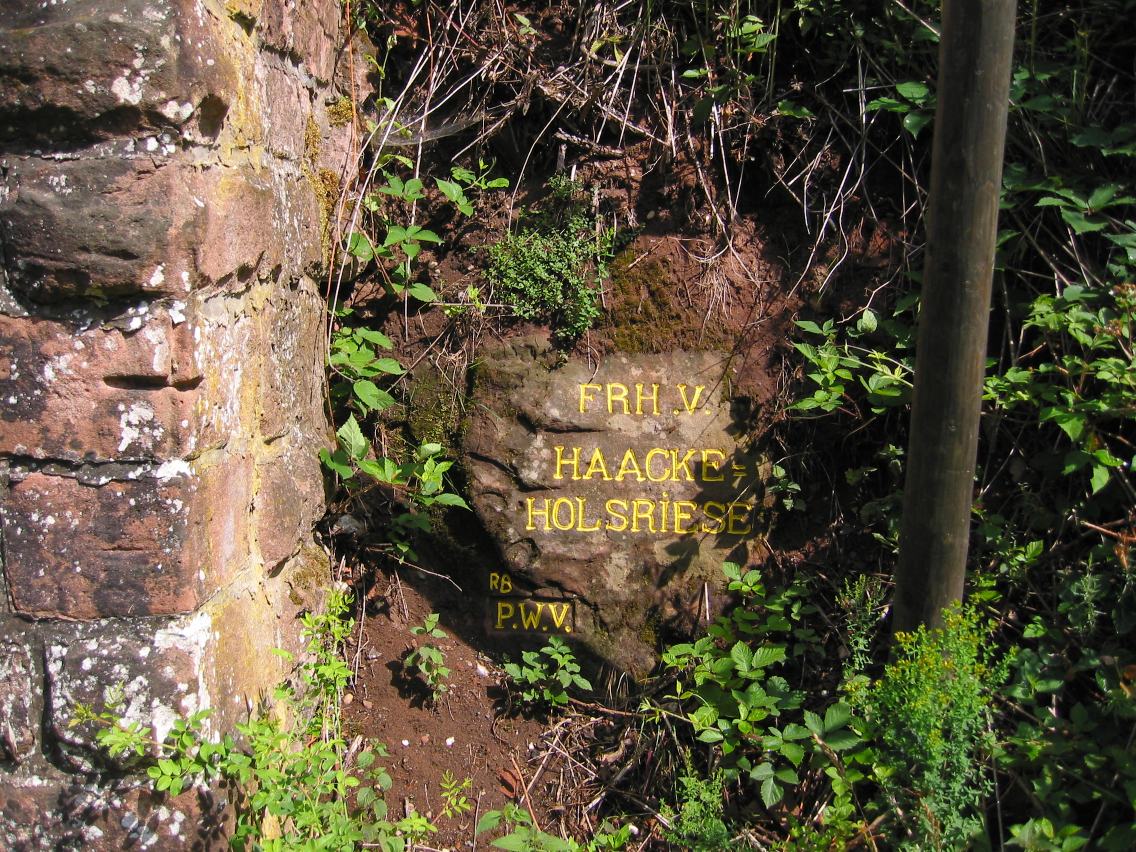
Ritterstein 121 "Frh. v. Haacke Holsriese"
DE
- Location
- DE
- Category
- iconic bucket list
- Coordinates
- 49.3500489, 7.8727574
- Best time
- Morning or early afternoon
- Weather tip
- Check the local forecast before visiting.
Overview
Ritterstein 121, known as 'Frh. v. Haacke Holsriese', is a historical marker located in Speyerbrunn, Germany. Situated near the eastern wall of the local church, this stone monument commemorates the site of a 'Holzriese'—a specialized wooden chute or slide used during the era of timber rafting. These structures were essential for the forestry industry, allowing logs to be transported down steep terrain to the Speyerbach stream, where they could be floated downstream for trade and construction. This particular chute was commissioned under the authority of Baron Ludwig Anton von Hacke, a significant figure in the regional forest management of the 18th century. For those interested in industrial heritage and local history, this site offers a glimpse into the logistical challenges of pre-industrial forestry. Visitors often include this marker as part of their trip ideas while exploring the surrounding Pfälzerwald region, which is famous for its dense forests and historical landmarks. As you plan your visit, you will find that these Rittersteine (Knight Stones) serve as vital markers of the region's cultural landscape. Whether you are a hiking enthusiast or a history buff, observing these stones provides a tangible connection to the economic lifeblood of the Palatinate forests. Exploring the Speyerbrunn area is a rewarding experience for anyone seeking to understand the historical infrastructure that once powered the local timber economy, making it a unique addition to your list of places to visit.
General information
Ritterstein 121, known as 'Frh. v. Haacke Holsriese', is a historical marker located in Speyerbrunn, Germany. Situated near the eastern wall of the local church, this stone monument commemorates the site of a 'Holzriese'—a specialized wooden chute or slide used during the era of timber rafting. These structures were essential for the forestry industry, allowing logs to be transported down steep terrain to the Speyerbach stream, where they could be floated downstream for trade and construction. This particular chute was commissioned under the authority of Baron Ludwig Anton von Hacke, a significant figure in the regional forest management of the 18th century. For those interested in industrial heritage and local history, this site offers a glimpse into the logistical challenges of pre-industrial forestry. Visitors often include this marker as part of their trip ideas while exploring the surrounding Pfälzerwald region, which is famous for its dense forests and historical landmarks. As you plan your visit, you will find that these Rittersteine (Knight Stones) serve as vital markers of the region's cultural landscape. Whether you are a hiking enthusiast or a history buff, observing these stones provides a tangible connection to the economic lifeblood of the Palatinate forests. Exploring the Speyerbrunn area is a rewarding experience for anyone seeking to understand the historical infrastructure that once powered the local timber economy, making it a unique addition to your list of places to visit.
Did you know
- Rittersteine are sandstone markers found throughout the Palatinate Forest that denote historical sites or geographic points of interest.
- The 'Holzriese' was a gravity-fed wooden slide used to transport timber from steep slopes to water sources.
- Baron Ludwig Anton von Hacke was a prominent 18th-century official who significantly influenced forestry practices in the region.
History
The site marks the location of a timber chute (Holzriese) established in the 18th century under the direction of Baron Ludwig Anton von Hacke. During this period, the Palatinate forests were heavily exploited for timber, which served as a primary resource for construction and fuel. The chute allowed workers to slide heavy logs down difficult mountainous terrain directly to the Speyerbach, where they were collected for rafting. The Ritterstein serves as a permanent historical record of this specific infrastructure, preserving the memory of the Baron's logistical efforts to streamline the forest industry in what was then a challenging, rugged environment.
Cultural significance
Ritterstein 121 is part of a larger network of sandstone markers known as the 'Rittersteine'. These stones were created by the Pfälzerwald-Verein to preserve local history and geography. They represent the cultural identity of the region, emphasizing the deep connection between the local population and the forest. By commemorating industrial sites like the Holzriese, the stone honors the labor and ingenuity of the people who shaped the landscape of the Palatinate. It acts as an outdoor museum, ensuring that the history of timber transport remains visible to modern hikers and residents.
Geography and landscape
The marker is located in Speyerbrunn, a small community nestled within the Pfälzerwald (Palatinate Forest). The terrain is characterized by rolling hills, dense deciduous and coniferous forests, and sandstone outcrops. The site itself is positioned near the church wall, providing a quiet, accessible point for visitors. The surrounding landscape is defined by the Speyerbach stream, which historically served as the main artery for the timber industry. The area is highly forested, creating a serene, natural environment that is typical of the southwestern German low mountain ranges.
More facts
- Imported from OSM batch
Visitor links
Nearby attractions
- Ritterstein 112 "R. Forsthaus Mückenwies" 399 m
- Ritterstein 94 "Erzgruben" 1109 m
- Ritterstein 122 "Weg erbaut Frh. v. Hacke 1737" 1275 m
- Ritterstein 109 "Welterstal" 1686 m
- Ritterstein 97 "R. Jagdhaus" 2054 m
- Ritterstein 98 "Speckhenrich" 2198 m
- Ritterstein 126 "Altes Forsthaus 15 Schr." 2867 m
- Ritterstein 108 "Haidhaldbrunnen 220 Schr." 2880 m