Manoppello Image
IT
- Location
- IT
- Category
- iconic bucket list
- Coordinates
- 42.2498203, 14.062373
- Best time
- Morning or early afternoon
- Weather tip
- Check the local forecast before visiting.
Overview
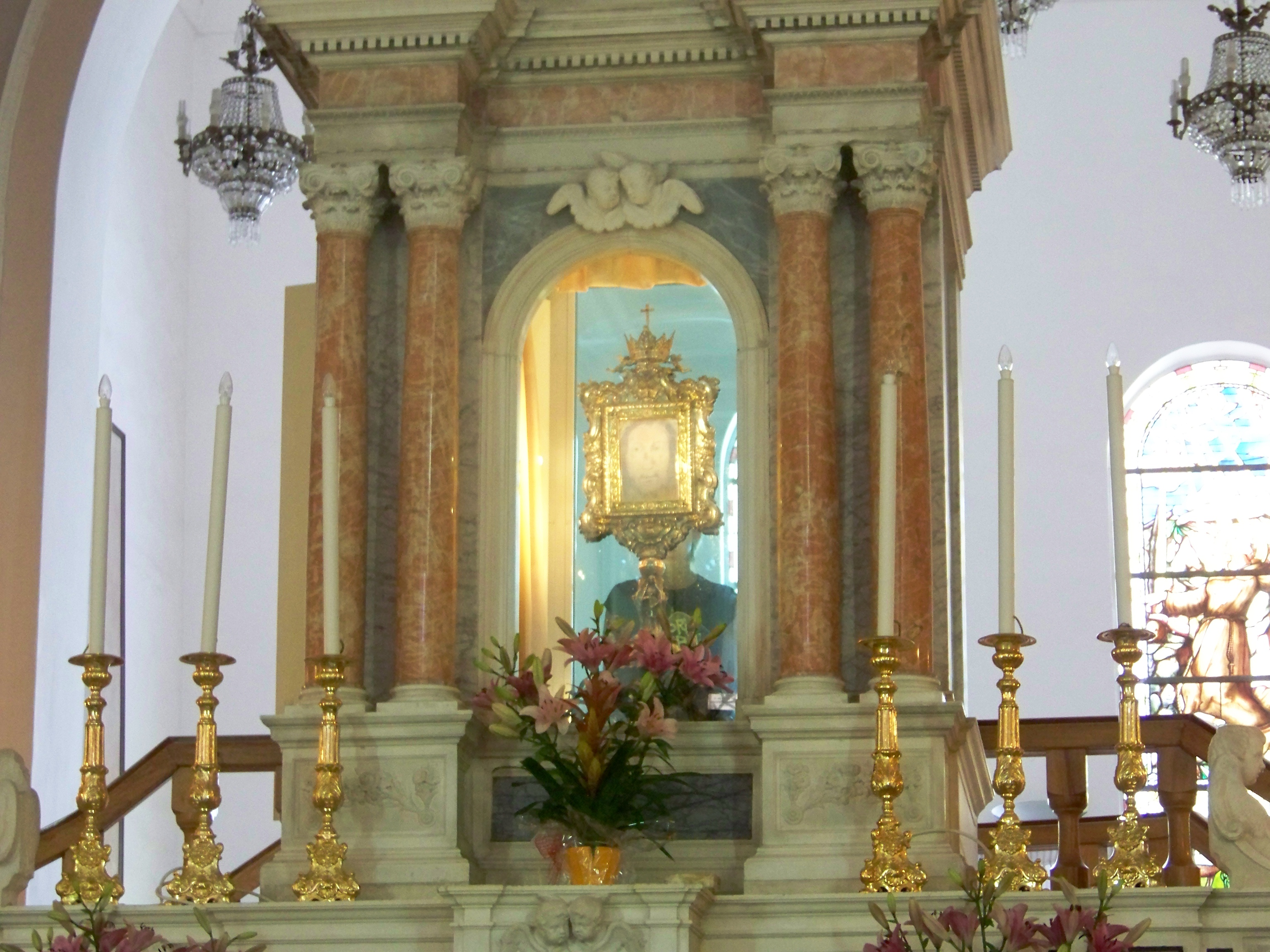
The Manoppello Image, also known as the Holy Face of Manoppello (Volto Santo di Manoppello), is an iconic relic housed within the Basilica of San Valentino in the town of Manoppello, Italy. This artifact consists of a thin, transparent veil measuring approximately 17 by 24 centimeters, bearing the image of a man's face. Unlike traditional paintings, the image is formed on a fabric made of byssus—a rare, ancient material often called 'sea silk.' Visitors flock to this site to witness a phenomenon that defies conventional artistic categorization, as the image is visible from both sides of the veil and appears to change appearance depending on the lighting conditions. For those planning their itinerary, exploring the religious heritage of the Abruzzo region offers excellent trip ideas for travelers interested in historical mysteries and sacred art. The Basilica provides a serene environment for reflection, making it a significant stop for pilgrims and curious tourists alike. When considering what to do in the area, a visit to this sanctuary offers a unique opportunity to engage with an object that has sparked decades of scientific and theological debate. The delicate nature of the veil requires it to be kept between two panes of glass, preserving its integrity for future generations while allowing the public to observe its enigmatic features up close.
General information
The Manoppello Image, also known as the Holy Face of Manoppello (Volto Santo di Manoppello), is an iconic relic housed within the Basilica of San Valentino in the town of Manoppello, Italy. This artifact consists of a thin, transparent veil measuring approximately 17 by 24 centimeters, bearing the image of a man's face. Unlike traditional paintings, the image is formed on a fabric made of byssus—a rare, ancient material often called 'sea silk.' Visitors flock to this site to witness a phenomenon that defies conventional artistic categorization, as the image is visible from both sides of the veil and appears to change appearance depending on the lighting conditions. For those planning their itinerary, exploring the religious heritage of the Abruzzo region offers excellent trip ideas for travelers interested in historical mysteries and sacred art. The Basilica provides a serene environment for reflection, making it a significant stop for pilgrims and curious tourists alike. When considering what to do in the area, a visit to this sanctuary offers a unique opportunity to engage with an object that has sparked decades of scientific and theological debate. The delicate nature of the veil requires it to be kept between two panes of glass, preserving its integrity for future generations while allowing the public to observe its enigmatic features up close.
Did you know
- The image is printed on byssus, a rare fiber produced by mollusks, which is notoriously difficult to dye or paint.
- The face on the veil matches the dimensions and facial features of the image found on the Shroud of Turin.
- The image disappears when viewed at certain angles, a property that remains a subject of modern optical study.
History
The history of the Manoppello Image is documented through local traditions and archives beginning in the 17th century. It was brought to the attention of the wider public in 1608 when Father Donato da Bomba recorded its arrival in the Capuchin monastery of Manoppello. According to these records, the veil was presented to a local doctor, Giacomo Antonio Leonelli, by an unknown pilgrim who vanished shortly thereafter. The relic remained in the Leonelli family until 1638, when it was donated to the Capuchin friars. While some researchers suggest the veil may have historical links to the 'Veil of Veronica' mentioned in medieval Roman accounts, its provenance remains a subject of ongoing historical and scientific investigation.
Cultural significance
The Manoppello Image holds profound cultural and religious significance as a focal point for Christian veneration in Italy. It is categorized as an 'acheiropoieton'—a term used for images believed to have been created without human agency. The annual feast days and the continuous stream of pilgrims highlight its role in the spiritual life of the Abruzzo region. Beyond its religious status, the artifact has become a cultural touchstone for scholars of art history, optics, and textile science, who analyze the unique properties of the byssus fabric and the mysterious application of the image, which lacks any trace of paint, ink, or pigment.
Geography and landscape
The Basilica of San Valentino is situated in the town of Manoppello, located in the province of Pescara within the Abruzzo region of central Italy. The town sits on a hillside overlooking the Pescara River valley, framed by the dramatic peaks of the Majella National Park. The landscape is characterized by rolling hills, olive groves, and traditional agricultural terraces typical of the Apennine foothills. The basilica itself is a modest yet historically rich structure that fits into the quiet, medieval urban fabric of the town, offering panoramic views of the surrounding mountainous terrain.
More facts
- Imported from OSM batch
Visitor links
Nearby attractions
- Abbazia di San Liberatore a Majella 3493 m
- Parco territoriale attrezzato Sorgenti solfuree del Lavino Province of Pescara - 3619 m
- Oratorio di Santa Maria delle Grazie 9497 m
- Fonte Grande 11688 m