Ludwig Dunhofer
Salzburg, IL
- Location
- Salzburg, IL
- Category
- iconic bucket list
- Coordinates
- 47.8114929, 13.0273182
- Best time
- Morning or early afternoon
- Weather tip
- Check the local forecast before visiting.
Overview
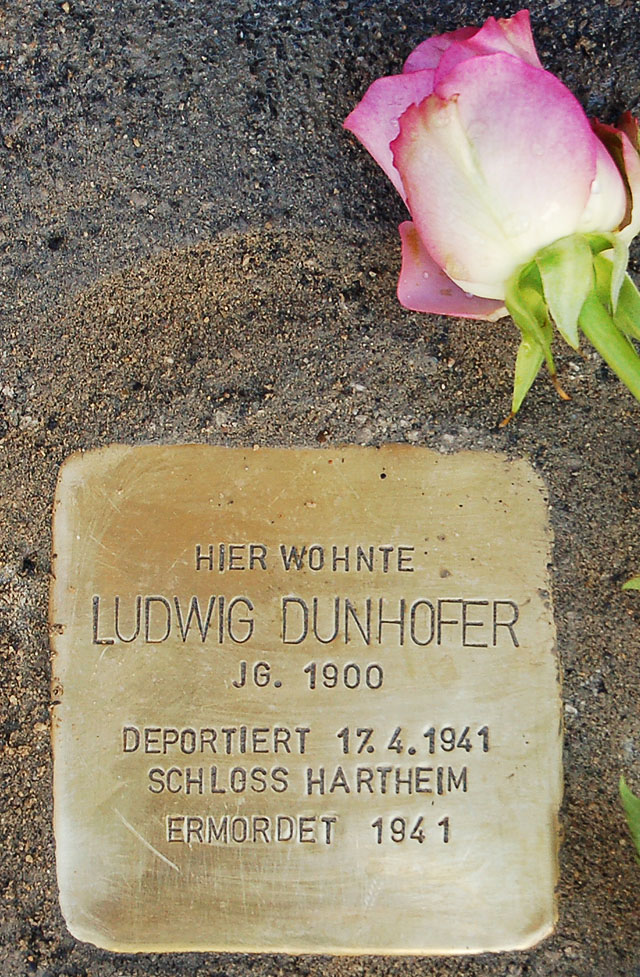
Ludwig Dunhofer is a Stolperstein, a brass-plated concrete cube embedded in the pavement of Salzburg, serving as a poignant memorial to Ludwig Dunhofer, a victim of Nazi persecution. This specific Stolperstein, located at Paris-Lodron-Straße 11, commemorates Dunhofer, born in 1904, who was arrested for homosexuality and deported to the Mauthausen concentration camp, where he died in 1941. Part of a larger European project initiated by artist Gunter Demnig, Stolpersteine aim to bring individual victims out of anonymity by placing their names and life details at their last known voluntary residence. These memorials are among the significant historical places to visit for those seeking to understand the human cost of historical events and reflect on the importance of remembrance. They offer a unique way to engage with local history and are a moving reminder of the past, encouraging visitors to pause and contemplate the lessons of history.
General information
Ludwig Dunhofer is a Stolperstein, a brass-plated concrete cube embedded in the pavement of Salzburg, serving as a poignant memorial to Ludwig Dunhofer, a victim of Nazi persecution. This specific Stolperstein, located at Paris-Lodron-Straße 11, commemorates Dunhofer, born in 1904, who was arrested for homosexuality and deported to the Mauthausen concentration camp, where he died in 1941. Part of a larger European project initiated by artist Gunter Demnig, Stolpersteine aim to bring individual victims out of anonymity by placing their names and life details at their last known voluntary residence. These memorials are among the significant historical places to visit for those seeking to understand the human cost of historical events and reflect on the importance of remembrance. They offer a unique way to engage with local history and are a moving reminder of the past, encouraging visitors to pause and contemplate the lessons of history.
Did you know
- The Stolpersteine project was initiated by German artist Gunter Demnig in 1992.
- Each Stolperstein is individually handcrafted and placed by hand, often by Demnig himself.
- The name 'Stolperstein' translates to 'stumbling stone,' intended to make passersby pause and 'stumble' upon a piece of history.
- Over 90,000 Stolpersteine have been laid in more than 1,200 cities and towns across 27 European countries.
History
Ludwig Dunhofer was born in Salzburg in 1904. He was arrested due to his homosexuality, which was criminalized under the Nazi regime. Subsequently, Dunhofer was deported to the Mauthausen concentration camp, where he tragically died on October 29, 1941. The Stolperstein project, which commemorates Dunhofer, began in 1992 with artist Gunter Demnig's first stone in Cologne, Germany. The project expanded rapidly throughout Germany and across Europe, aiming to provide a personal memorial for victims of Nazi persecution at their last known address. Ludwig Dunhofer's Stolperstein was laid on November 19, 2013, at Paris-Lodron-Straße 11 in Salzburg, marking his last voluntarily chosen residence.
Cultural significance
The Stolpersteine project holds profound cultural significance as Europe's largest decentralized memorial. Its primary aim is to bring individual victims of Nazi persecution out of the anonymity of statistics, restoring their names and personal stories to public memory. By embedding these brass plaques into the urban landscape at the victims' last known addresses, the Stolpersteine create a direct, personal connection between the past and the present. They serve as constant, subtle reminders of the atrocities committed during the Nazi era, fostering collective memory and encouraging reflection on human rights, tolerance, and the dangers of persecution. This form of remembrance ensures that individual fates are not forgotten and acts as a powerful educational tool against historical revisionism and rising intolerance.
Geography and landscape
The Ludwig Dunhofer Stolperstein is situated within the urban fabric of Salzburg, specifically embedded in the pavement at Paris-Lodron-Straße 11. This location is characteristic of the Stolpersteine project, which places these small memorials directly into the pedestrian environment, often in front of the victim's last voluntarily chosen residence. The physical appearance is a 10x10 cm brass-plated concrete cube, designed to be unobtrusive yet noticeable. Its integration into the everyday landscape means it becomes part of the city's living memory, contrasting its small physical presence with the immense historical weight it carries. The surrounding area is typical of a European city street, with buildings, sidewalks, and daily pedestrian traffic, emphasizing the project's goal of bringing remembrance into the public sphere.
More facts
- Imported from OSM Overpass
Visitor links
Nearby attractions
- Franz Seiwald Salzburg - 65 m
- Fotohof Salzburg - 231 m
- Emma Neumayr Salzburg - 265 m
- Literaturhaus Salzburg Salzburg - 405 m
- Therese Flachberger Salzburg - 438 m
- Ingeborg Ortner Salzburg - 452 m
- Karl Schuch Salzburg - 453 m
- Johann Reiter Salzburg - 454 m