Le Départ des volontaires de 1792
Paris, FR
- Location
- Paris, FR
- Category
- heritage historic sites
- Coordinates
- 48.8738566, 2.2952882
- Best time
- Morning or early afternoon
- Weather tip
- Check the local forecast before visiting.
Overview
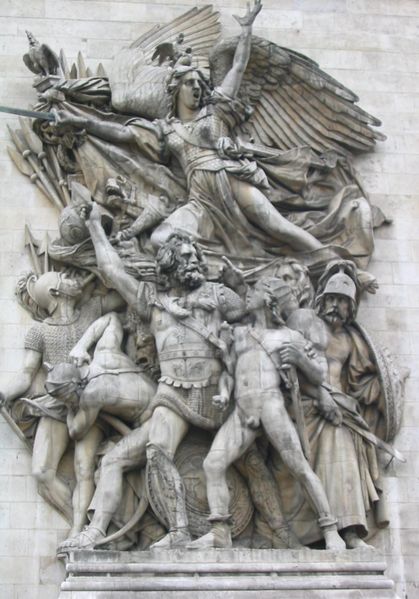
Le Départ des volontaires de 1792, widely known as La Marseillaise, is a monumental high-relief sculpture by François Rude, prominently featured on the right-hand pier of the Arc de Triomphe in Paris. Commissioned in 1833 by Adolphe Thiers, the Minister of War, the sculpture commemorates the mobilization of French volunteers during the Wars of the French Revolution. As one of the most significant sculptural works of the Romantic period, it depicts a group of volunteers led by a winged personification of Liberty, also known as the Genius of War. Visitors to Paris often include this masterpiece in their itinerary as they explore the city’s rich historical landmarks. When considering what to do in the area, observing the intricate details of the limestone carving provides a profound connection to the revolutionary spirit of 18th-century France. The work is celebrated for its dynamic composition and emotional intensity, capturing the fervor of citizens rushing to defend their young republic. For those seeking inspiration for trip ideas, this site serves as a perfect starting point for understanding French national identity through art. The relief is best viewed during the morning or early afternoon when natural light highlights the dramatic musculature and expressive faces of the figures, allowing visitors to appreciate the technical mastery of Rude’s tribute to the soldiers of the First Republic.
General information
Le Départ des volontaires de 1792, widely known as La Marseillaise, is a monumental high-relief sculpture by François Rude, prominently featured on the right-hand pier of the Arc de Triomphe in Paris. Commissioned in 1833 by Adolphe Thiers, the Minister of War, the sculpture commemorates the mobilization of French volunteers during the Wars of the French Revolution. As one of the most significant sculptural works of the Romantic period, it depicts a group of volunteers led by a winged personification of Liberty, also known as the Genius of War. Visitors to Paris often include this masterpiece in their itinerary as they explore the city’s rich historical landmarks. When considering what to do in the area, observing the intricate details of the limestone carving provides a profound connection to the revolutionary spirit of 18th-century France. The work is celebrated for its dynamic composition and emotional intensity, capturing the fervor of citizens rushing to defend their young republic. For those seeking inspiration for trip ideas, this site serves as a perfect starting point for understanding French national identity through art. The relief is best viewed during the morning or early afternoon when natural light highlights the dramatic musculature and expressive faces of the figures, allowing visitors to appreciate the technical mastery of Rude’s tribute to the soldiers of the First Republic.
Did you know
- The sculpture is colloquially referred to as 'La Marseillaise' because it evokes the spirit of the French national anthem.
- François Rude was awarded the Legion of Honor for this work following its inauguration in 1836.
- The Genius of War figure is depicted with an open mouth, as if shouting a battle cry to inspire the volunteers.
History
Commissioned in 1833, the relief was part of the broader decorative program for the Arc de Triomphe, which was intended to glorify the armies of the Revolution and the Empire. François Rude spent three years working on the piece, completing it in 1836. The sculpture captures the historical moment of 1792, when the Legislative Assembly declared war on Austria, prompting a massive wave of voluntary enlistment among the Parisian population. By choosing to depict this specific event, the work anchors the Arc de Triomphe in the foundational era of the French Republic, distinguishing it from the later Napoleonic victories depicted elsewhere on the monument.
Cultural significance
The work holds immense cultural significance as an icon of French Romanticism and national pride. It transformed the image of the soldier from a professional warrior to a citizen-soldier, reflecting the democratic ideals of the French Revolution. The figure of Liberty, with her fierce, forward-moving posture, became a potent symbol of French resistance and defiance. Throughout the 19th and 20th centuries, the image of 'La Marseillaise' has been reproduced in countless prints and textbooks, cementing its status as an essential visual component of French collective memory and the national ethos of liberty.
Geography and landscape
The relief is situated on the Place Charles de Gaulle, formerly Place de l'Étoile, in the 8th arrondissement of Paris. It is carved directly into the stone pier of the Arc de Triomphe, which stands at the center of a massive traffic circle where twelve avenues converge. The location is highly urban, characterized by the dense, neoclassical architecture of the Haussmann era. As an outdoor attraction, it is subject to the ambient noise and bustle of Parisian traffic, yet the scale of the monument provides a sense of monumental gravity amidst the surrounding city landscape.
More facts
- Imported from OSM batch
Visitor links
Nearby attractions
- Tomb of the Unknown Soldier Paris - 16 m
- Flame of Remembrance Paris - 17 m
- Toit de l'Arc de Triomphe Paris - 21 m
- Arc de Triomphe Paris - 23 m
- La Paix de 1815 Paris - 26 m
- Le Triomphe de 1810 Paris - 31 m
- La Résistance de 1814 Paris - 41 m
- Maurice Ravel Paris - 183 m