Khan al-Umdan
Acre, IL

- Location
- Acre, IL
- Category
- heritage historic sites
- Coordinates
- 32.9199789, 35.0690215
Overview
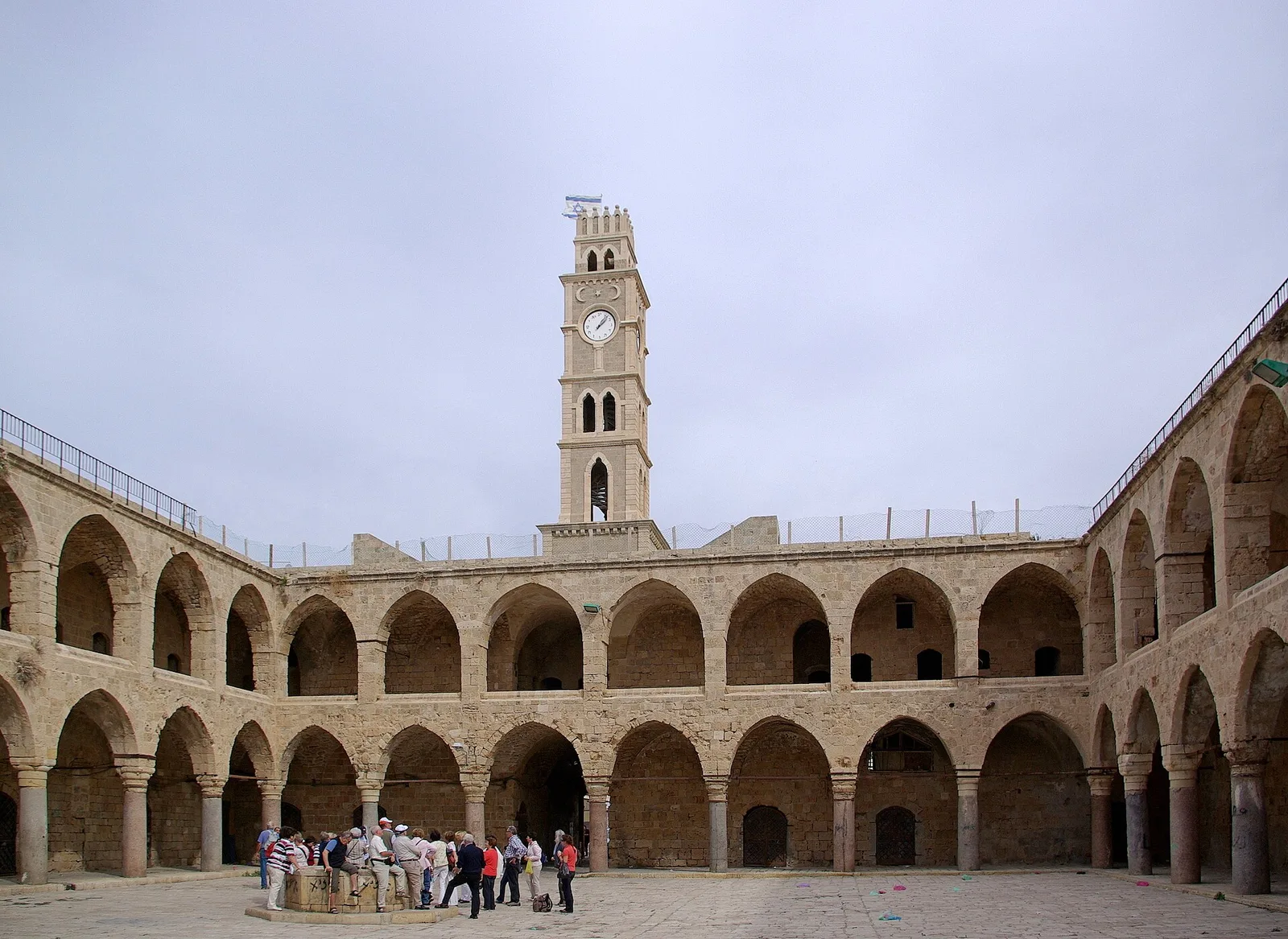
Khan al-Umdan, or the "Inn of the Columns," stands as the largest and best-preserved caravanserai in Israel. Constructed in the late 18th century by the Ottoman governor Ahmed al-Jazzar, this architectural landmark served as a vital hub for international merchants arriving at the bustling Port of Acre. Visitors today are drawn to its grand two-story structure, which features a vast central courtyard surrounded by impressive granite and marble columns salvaged from ancient sites like Caesarea. As one of the most prominent places to visit in the Old City, the Khan offers a window into the maritime commerce of the Ottoman era. A striking feature of the site is the ornate clock tower situated above the main entrance, added in the early 20th century to commemorate the silver jubilee of Sultan Abdülhamid II. While the building undergoes ongoing preservation and development projects, it remains a primary attraction for those seeking trip ideas in the northern coastal region. The site effectively illustrates Acre's historical status as a global trade gateway, blending functional commercial architecture with aesthetic grandeur.
General information
Khan al-Umdan, or the "Inn of the Columns," stands as the largest and best-preserved caravanserai in Israel. Constructed in the late 18th century by the Ottoman governor Ahmed al-Jazzar, this architectural landmark served as a vital hub for international merchants arriving at the bustling Port of Acre. Visitors today are drawn to its grand two-story structure, which features a vast central courtyard surrounded by impressive granite and marble columns salvaged from ancient sites like Caesarea. As one of the most prominent places to visit in the Old City, the Khan offers a window into the maritime commerce of the Ottoman era. A striking feature of the site is the ornate clock tower situated above the main entrance, added in the early 20th century to commemorate the silver jubilee of Sultan Abdülhamid II. While the building undergoes ongoing preservation and development projects, it remains a primary attraction for those seeking trip ideas in the northern coastal region. The site effectively illustrates Acre's historical status as a global trade gateway, blending functional commercial architecture with aesthetic grandeur.
Did you know
- The granite and marble columns used in the courtyard were not newly quarried; they were repurposed from the ruins of ancient Caesarea and Sebastia.
- The clock tower above the entrance is one of seven built throughout the Land of Israel to celebrate the 25th year of Sultan Abdülhamid II's reign.
- The ground floor was historically used for warehouse storage and stables, while the upper floor served as living quarters for traveling merchants.
History
Khan al-Umdan was commissioned in 1784 by Ahmed al-Jazzar, the Ottoman governor famous for successfully defending Acre against Napoleon Bonaparte. The structure was built on the site of a former Crusader customs house to facilitate the city's growing role in the grain and textile trade. For over a century, it functioned as a commercial exchange and lodging for merchants from across the Mediterranean. In 1906, the iconic clock tower was added to the main gate, marking the final major Ottoman architectural contribution to the site. Following the decline of Acre's port in the 20th century, the building transitioned from a commercial hub to a historical monument, and it is currently undergoing extensive restoration to preserve its structural integrity for future generations.
Cultural significance
As a UNESCO World Heritage site component, Khan al-Umdan represents the pinnacle of Ottoman urban planning and commercial architecture in the Levant. It serves as a physical testament to the multicultural history of Acre, where European, Arab, and Ottoman interests converged. The Khan is not only an architectural icon but also a symbol of the city's resilience and historical wealth. Its image, particularly the clock tower and the rhythmic arches of the courtyard, is frequently used in art and photography to represent the identity of Old Acre. It remains a central landmark in the collective memory of the local community, reflecting the city's golden age as a Mediterranean trade powerhouse.
Geography and landscape
Located in the heart of Old Acre, Khan al-Umdan is situated immediately adjacent to the city's ancient harbor. The structure is built on reclaimed land that once formed part of the Crusader-era port facilities. Its geography is defined by its proximity to the Mediterranean Sea, which dictated its function as a maritime inn. The surrounding landscape is characterized by narrow, winding limestone alleys typical of a fortified medieval and Ottoman city. The Khan’s massive square footprint dominates the southern section of the Old City, providing a stark contrast to the dense residential quarters nearby. From the upper levels, one can observe the intersection of the city's stone fortifications and the blue waters of the bay.
Visitor links
Nearby attractions
- Acre Port Acre - 90 m
- Foundations of Crusader Templar Fortress Acre - 286 m
- Turkish bazaar Acre - 308 m
- Hammam al-Pasha, Acre Acre - 322 m
- Tower of Flies Acre - 326 m
- El-Majdila Mosque Acre - 348 m
- Muzeʼon ʻOkashi Acre - 358 m
- Hall of the Crusader Knights Acre - 412 m